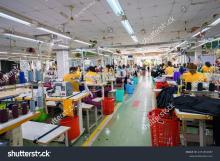
The apparel value chain is essential for the livelihood of millions of workers around the globe, but working conditions in this sector are far from satisfactory. The circular economy has been used by businesses as a framework for achieving sustainability but there is a lack of knowledge about its social impact.
This paper explores the social impact of the different circular strategies implemented in the Netherlands, Spain and India. It assesses social impacts related to the quality of jobs, workers’ sustainable livelihood and gender equality and inclusion.
It finds that the social ambition of the circular economy is low, and that current circular strategies follow the same feminisation and precariousness of working conditions found in the linear apparel value chain.
This paper examines the socio-environmental justice aspects of 11 key EU policies guiding the textile industry's journey towards circularity.
It found that action is needed to tackle overproduction and overconsumption in the EU Strategy for Sustainable and Circular Textiles. Steps must be taken to address the impacts of EU circular economy textile policies on the Global South so as to ensure positive social and environmental outcomes.
The paper also concluded that efforts are needed to make just transition policies globally accountable and alleviation mechanisms integral to the Textile Strategy rather than supplementary corrective measures. Meaningful participatory mechanisms are needed that ensure the democratic inclusion of different views and actors.
Transformative circular futures in the textile and apparel value chain: Guiding policy and business recommendations in the Netherlands, Spain, and India
Circular economy practices are gaining importance in the global textile and apparel value chain. However, the circular economy's social dimension is often overlooked.
To address this problem, this study develops transformative circular futures (TCFs), co-created circular economy scenarios that are diverse and systemic and embed social impact considerations. The aim is to inform policy and business decision making in the textile and apparel value chains of India, the Netherlands and Spain.
The study recommends normalising living wages for direct, indirect and informal workers, implementing regulations challenging the patriarchy, eliminating gender pay and establishing permanent global committees of social actors.
Walking the circular talk: Analyzing the soft and hard aspects of circular economy implementation of ten business cases within the textile and apparel value chain
Companies in the textile and apparel value chain have been increasingly implementing circular economy practices. However, implementation has focused on the techno-environmental (hard) dimension, and partly overlooked the (soft) social dimension. There is a lack of empirical knowledge about how businesses in this value chain simultaneously manage soft and hard aspects of circularity and what kind of socio-environmental impact they generate.
This research analysed the soft and hard aspects of ten circular business cases from three countries. It demonstrates that both aspects are integral components of a comprehensive transformative circular transition framework that facilitates the adoption of more inclusive and circular practices while improving sustainability performance.
Are you working on a topic related to the circular economy? Are you new to the circular economy but want to find out more? Then don't miss Circular Wallonia's Quinzaine de l’économie circulaire 2024 (Circular Economy Fortnight 2024)!
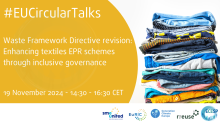
The ECESP Leadership Group on Textiles organised the #EUCircularTalks event on the revision of the Waste Framework Directive: Enhancing textiles EPR schemes through inclusive governance. Panellists discussed key evidence concerning how best to align waste management practices with sustainability goals.
This webinar took a closer look at the proposed changes to EPR schemes for textiles and highlighted the role of inclusive governance in meeting the sustainability targets.
Come and find out about the report quantifying the socioeconomic benefits of the second-hand clothing sector in the European Union and the UK (EU27+), Ghana, Kenya and Mozambique. Its findings offer insights into the global circular textiles value chain, socioeconomic impacts and the policies shaping this crucial industry.
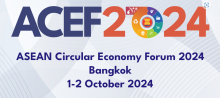
The 2024 ASEAN Circular Economy Forum (ACEF2024) will focus on Guiding the Transition – ASEAN and EU Approaches to Circular Innovation and Entrepreneurship.
The Forum aims to support innovation and entrepreneurship for a circular transition, showcase existing circular economy practices in the ASEAN region and build on ASEAN's traditions and values for a circular transition.
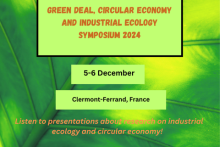
The Green Deal, Circular Economy and Industrial Ecology Symposium 2024 will take place on 5-6 December at the MSH Clermont in Clermont-Ferrand. It will bring together researchers and practitioners who will present their research on industrial ecology and circular economy.
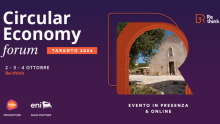
Re-think Taranto 2024 will explore macro-trends, possible evolutionary paths and key circular economy projects at local, national and international level.
The event will focus on Energy transition and sustainable mobility, Water management and the blue economy and Using materials and waste.