The Horizon Europe POLYMEER project aims to establish a sustainable bio-based value chain for bioplastic products. By efficiently converting wet brewers’ spent grain into high added value materials, it is endeavouring to diversify the array of innovative material solutions capable of replacing traditional plastics.
The report presents the progress the Commission has made in implementing the 2022 strategy for the outermost regions. It shows that the Commission has delivered on its commitment to reflect the outermost regions’ characteristics in legislative proposals, policy initiatives and programmes.
The outermost regions have high potential to develop circular economy solutions. Cohesion policy supports circular economy development there. Both the ERDF and Interreg support waste management and recycling, for instance in Réunion with EUR 18 million of ERDF funding dedicated to the circular economy. Outermost regions also benefit from support under the LIFE programme. Several of these regions have designed circular strategies, such as the Circular Economy Conference of the Azores.
Purman Recycling and Processing Ltd. has developed the purman® method, a mechanical recycling process for rigid polyurethane (PU) and polyisocyanurate (PIR) foams.
The UNLOCK project focuses on turning waste feathers into products for the agricultural industry, such as mulch film. It is organising a networking event focusing on advancing the circular economy within the agricultural sector. Come and discuss the benefits of feathers!
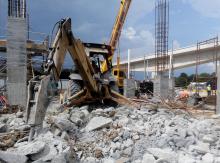
Concrete accounts for 8% of the world's CO2 emissions. Efforts are being made to reduce its embodied carbon, but reusing concrete from existing buildings has significant untapped potential.
This study presents an innovative digital workflow for predicting the lifespan of concrete elements, CO2 uptake via natural carbonation and embodied carbon savings through reuse. The workflow was tested in a building from the 1960s with high reuse potential.
It found that most precast elements would last long enough to be reused effectively and that reuse is better for the environment than carbonation.
The digital workflow is useful for quickly assessing lifespan, carbonation and embodied carbon of concrete. It is a useful tool when designing for reuse.
The European Sustainable Phosphorus Platform (ESPP) is organising a workshop on the legal status of biomass produced in wastewater treatment or with waste gas, manure or food waste inputs, to be used in fertilisers, feeds and industry.
Feedstocks for Plastics Recycling will focus on unlocking the value of Europe’s plastics waste streams. It will be an opportunity to explore the challenges and possibilities of acquiring feedstock for recycling in Europe.
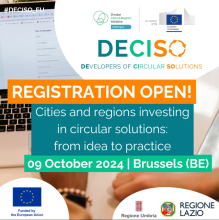
DECISO (DEvelopers of CIrcular SOlutions) is a Horizon Europe project running from 2023 to 2025 which will assist European cities and regions with developing financing schemes for circular economy initiatives. This year, its annual conference will focus on Cities and regions investing in circular solutions: from idea to practice.
The RECERCO project recovered fired sherds, a form of waste generated when manufacturing ceramic tiles. It proved that it is feasible to use this as a secondary raw material for manufacturing new ceramic tiles and as a reinforcement agent for polymeric matrices to obtain composites for the construction industry.