Academics are studying the challenge of including the informal recycling sector (IRS) in the circular economy.
This review explores the direct and indirect contributions of the IRS to various circular economy fields, drawing on relevant literature.
The modi operandi of different recycling value chains are captured in a typology.
Information on reported forms of collaboration, tensions and challenges in urban waste management is summarised in a conceptual framework to facilitate the transition to circular and inclusive wise-waste systems.
Important aspects related to circular business models and approaches to the IRS are discussed and avenues for further research proposed.
The first episode of the Biocircularcities Trilogy unveils the story behind the success of the BBI-JU Biocircularcities project or how partners supported a transition of the pilot territories toward circular bioeconomy through a collaborative approach.
The EU has set ambitious targets to improve municipal waste management. EU Member States need effective strategies and policy instruments to achieve these targets.
This briefing provides an overview of some of the main instruments used across the EU and the performance of Member States so far.
Economic instruments can be useful policy tools for waste prevention and sustainable waste management. This is because they can make preferred management options, such as recycling, cheaper than or at least cost-competitive with their alternatives.
Like economic instruments, well-designed separate collection systems for municipal waste are a key enabler of high recycling rates and the collection of recyclables of adequate quality.
Europe aims to become a circular economy. To encourage this, the EU has set targets for the 27 Member States to increase recycling and reduce landfilling. Specifically, by 2025, 55% of municipal waste and 65% of packaging waste must be prepared for re-use or recycled.
This briefing assesses Member States’ prospects of meeting these targets and its findings constitute the basis of the European Commission’s 2023 early warning report.
This document compiles a set of country-specific reports describing the progress made by each European country towards waste prevention and decoupling of waste generation. Each report explains their national waste prevention programmes and food waste prevention and product reuse policies with a view to the circular economy.
Separate links are offered in the document for each country report.
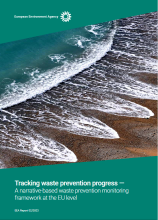
This report proposes a new framework for monitoring waste prevention. The framework consists of three clusters of indicators:
the system where prevention is implemented
policy enablers focusing on waste prevention measures, and
waste prevention outcomes.
Given that waste prevention occurs over time, this report seeks to assess longer term trends in waste prevention.
This comprehensive monitoring framework allows for a broader understanding of waste generation and prevention. However, the data collected were not sufficient for an in-depth analysis of waste prevention progress or for assessing the effectiveness of specific prevention measures. For a deeper analysis, more specific data and information need to be collected across EU countries in a systematic and harmonised way.
The EU economy uses unsustainably large amounts of materials. In 2021, only 11.7% of these materials came from recycled waste. This share of recycled material is known as the circular material use rate (CMUR) and over the last 20 years it has increased only slightly. The EU’s circular economy action plan aims to double that share by 2030.
This briefing looks at trends in the EU’s circular material use rate and the environmental impacts of material use. It also analyses the EU’s prospects for reaching its 2030 target. Efforts should focus on reducing use and increasing recycling of non-metallic minerals — such as construction materials — as these account for about half of all materials used.
The Directorate General for Internal Market, Industry, Entrepreneurship and SMEs (DG GROW) of the European Commission has launched work on a study regarding “Background Data Collection for Future EU End-of-Waste Criteria of Construction and Demolition Waste”.
In this context, the Commission is opening an online stakeholder survey, available until 31 August 2023.
Kosovo, a potential EU candidate country, has embarked on an ambitious journey – the transition towards a circular economy. The aim of this journey is:
to preserve the country’s nature and rich biodiversity
to valorise its resources and talent,
to contribute to a more resilient and regenerative economy and a society where everyone has the opportunity to live a good life.
This roadmap by Kosovo's Ministry of Environment, Spatial Planning and Infrastructure identifies six priority areas: a) food and b) forestry systems, c) creative and d) retail sectors, e) built environment and the f) manufacturing sector.
Given the strong interdependency of these sectors, the Roadmap also introduces horizontal areas that enable and support priority areas and further promote circular transition.
Lieze works as the head of the international policy unit at OVAM, the Public Waste Agency of Flanders, which ensures that Flanders deals with waste, materials and soil in a well thought out and environmentally sound manner. Since 1981, OVAM has been developing a balanced mix of economic and regulatory instruments on waste, materials and soil that has made the Region of Flanders one of the frontrunners in Europe in this field.
We are joining forces with our partners in business, civil society, research and government to develop a circular economy, taking a multi-stakeholder participatory approach. Circular Flanders, which was initiated by OVAM, serves as hub, inspiration and matchmaker for the transition to a circular economy in Flanders. We implement measures that go beyond sorting and recycling waste to make a systemic shift from take-make-waste to a new economic model that factors in the scarcity of raw materials and the ecological limits of our planet.