What do consumers feel about upcycled food? Completing this FOODRUS survey by the University of Copenhagen takes only 5 to 7 minutes and will help design more sustainable food chains.
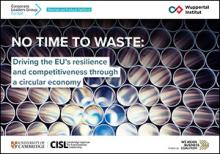
For the EU’s Green Deal to be effective, it is critical to target the root cause of the triple environmental crises of climate change, pollution and biodiversity loss: excessive extraction, production, manufacturing and consumption of material resources.
This excess is not evenly distributed in the world: as highlighted in the report, the EU consumes more than its fair share – levels that are almost double the estimated sustainable consumption levels.
Addressing material resource consumption by establishing an EU Material Resources Law will be critical to meet the fourfold objectives set out in the Circular Economy Action Plan (CEAP) and stay within planetary boundaries. The EU will not achieve its climate change targets without making progress on resource consumption.
This webinar on 24 January will introduce key organisations and resources at the regional and national levels, as well as host a first discussion amongst participants on experiences, interests, and challenges for cities and regions to enable a transition to a circular economy.
PACCT for Sustainability (Product as a service to Accelerate Cooperation and Circular Transformation) is a new community, aiming to reinvent the business landscape in Europe by prioritising sustainable and responsible practices.
A webinar will be held on 6 February in order to launch the PACCT community, exploring:
The challenges of "Product as a Service" models and the Economy of Functionality
The launch of the European community aiming to accelerate the transformation of the economy
PACCT for Sustainability aims to make service and sustainability the keystone of businesses across Europe and to build a European community focused on Product as a Service.
With the support of ADEME, Michelin, BASF and Johnston Circular, PACCT for Sustainability strives to rethink traditional economic models so as to speed up the sustainable transformation of the economy. It will do so by developing innovative business models aiming to replace an approach based on volume and products with a service geared towards customers and impact.
The platform organises webinars exploring different aspects of the sustainable economy, from value proposition to governance and financing, and workgroups where participants can co-create solutions.
FOODRUS is a European Horizon 2020 project aiming to build resilient local food systems in Europe by developing circular solutions to limit food loss and waste along the agri-food value chain. As part of this mission, FOODRUS will be holding three workshops in Spain on 31 January and 1 February 2024 during the FOODRUS: Reduciendo el desperdicio alimentario (#ReducingFoodWaste) event.
Following the success of the first FOODRUSroundtable in October 2023, on Tuesday 23 January, ACR+ will be holding the second policy roundtable on Recommendations to Overcome Barriers in Food Waste Prevention and Reduction. It will take place online from 15:00 to 17:00 CET and you are all welcome to participate!
“The Road to Green” is a Euronews magazine in collaboration with DG ENV of the Commission. It features monthly 8-minute videos, delivered in a road trip format, covering Europe’s continuing transformation to a circular, net-zero, nature-positive and clean economy.
The 8th World Circular Economy Forum hits Brussels from 15 to 18 April 2024 to turn circular visions into actions. The world’s leading event for circular economy thinkers, doers and leaders will showcase the most impactful circular solutions from Europe and around the world. Online participation is open to everyone.
The Climate Chance Europe 2024 Wallonia Summit will take place on 8 and 9 February 2024 in Liège, Belgium, and organisers are calling for contributions from across the European Union!
Promoters of selected climate actions will be able to present them at the Pitch Corner. These actions will also be published on the Cartography for action, which lists good practices and innovative climate initiatives that can be replicated on a larger scale. Circular economy projects as covered as part of the economic transition.