Berlin began its circular economy transition in 2020 with the adoption of the Waste Management Concept 2020-2030, aiming to implement measures to reduce household, water and construction waste. To advance this transition, it established the Coordination Office for Circular Economy, Energy Efficiency and Climate Protection in Business in 2022 and the Zero Waste Agency in 2023, and commissioned a study to analyse the circular economy’s potential in the industrial sector.
Despite these efforts, the circular economy in Berlin is still often perceived only in terms of sustainable waste management. This paper looks at challenges holding back progress on the circular economy, including policy coherence, and provides recommendations to accelerate the transition.
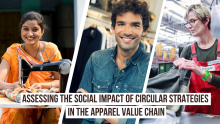
This report is part of a larger, collaborative four-year research project. It analyses the fashion value chain from a global and local perspective with an emphasis on India, Spain and the Netherlands, using a novel framework to assess social impact for circular economy called the SIAF-CE.
The report concludes that the Dutch circular ambition in policy is high and a solid ecosystem is in place. The most established circular strategies are resale and recycling, while promising ones are resale-platform-based, rental and repair. However, the social impact of most circular strategies seems to emulate linear value chain working conditions, where women workers hold the most vulnerable jobs, with low pay, short-term contracts and lower collective bargaining.
The sustainability certification TCO Certified has been driving social and environmental sustainability in the IT industry for over 30 years. Every third year, the certification criteria are updated to push sustainability where it matters most.
They are organising an event where they will discuss the steps needed to drive sustainability in four key areas (climate, substances, circularity and supply chain) and present their new Roadmap for Sustainable IT.
On 12 November, the European portal for energy efficiency and renewable energy in buildings BUILD UP is hosting the sixth and last webinar, part of a series of six webinars organised with the COST Action project on ‘Stakeholder Webinar Series – Deconstruction and Demolition Teams & Waste Management Industry’.
incommon is a non-profit organisation that encourages people to adopt the circular economy as a way of life. They use a bottom-up approach, working with individuals, schools, businesses, institutions, groups and local authorities.
Their approach ensures that people are informed about circular economy principles and engaged in implementing them, enabling them to make sustainable choices and drive local change.
The European Commission is opening a call for membership applications for a new Ecodesign Forum under the Ecodesign for Sustainable Products Regulation. The forum will play an important role in the implementation of the ESPR by involving all stakeholders in developing rules for more circular, energy-efficient and sustainable products.
The European Commission's Joint Research Centre is organising a second consultation meeting with stakeholders as part of its ongoing work on a preparatory study on textile products. This will support the implementation of the recently adopted Ecodesign for Sustainable Products Regulation.
Renewaball introduced the world’s first fully circular tennis and padel balls, designed with recycled materials sourced from used balls collected across European clubs.
This project embodies eco-friendly design by reusing rubber from old balls and using biodegradable wool felt to replace conventional polyester and nylon, which reduces microplastic pollution.
SUSTAINair was an H2020-funded project developing circular economy principles for the aviation and aerospace design, manufacturing, operations and end-of-life phases.
This paper examines the socio-environmental justice aspects of 11 key EU policies guiding the textile industry's journey towards circularity.
It found that action is needed to tackle overproduction and overconsumption in the EU Strategy for Sustainable and Circular Textiles. Steps must be taken to address the impacts of EU circular economy textile policies on the Global South so as to ensure positive social and environmental outcomes.
The paper also concluded that efforts are needed to make just transition policies globally accountable and alleviation mechanisms integral to the Textile Strategy rather than supplementary corrective measures. Meaningful participatory mechanisms are needed that ensure the democratic inclusion of different views and actors.