Atelier Riforma started as a social economy startup with a pioneer marketplace for upcycled garments. Realising that the sorting and cataloguing of textile waste were too labour-intensive for industry standards, founders came up with the idea of developing an AI-based automated solution - called Re4circular - to create a digitized and truly efficient post-consumer clothing supply chain.
The Madeira Circular Agenda bolsters the position of the Autonomous Region of Madeira (RAM) as a circular economy hotspot.
It involves civil society and public and private entities in a system that seeks to keep materials in the economy, and to promote efficiency, circularity and sustainability as competitiveness and differentiation factors for the regional economy. The Agenda also aims to ensure that RAM companies act as circular economy leaders in their respective sectors, adopting best practices and creating innovative solutions based on circularity principles, particularly in sectors deemed critical for the region, namely agri-food, construction, tourism, social sector and the sea.
This study aims to gain insight into how the transition to a more circular economy could impact the labour market, with a focus on net job creation or loss, job creation at different skill levels and geographical job concentration.
The methodology used was a combination of literature review and exploratory data analysis, the latter mainly focused on the Belgian region of Flanders.
It concluded that the transition will positively affect employment for vulnerable groups and reduce overall unemployment. The transition also has the potential to reduce the educational and geographical mismatches present in the Flemish labour market.
However, opportunities will vary between regions and the quality of jobs is key (some jobs in the waste sector are 'dirty jobs').
Within the framework of the Circular Economy Initiative Deutschland (CEID) and its three interdisciplinary and cross-sectoral working groups, more than 130 experts from industry, science and civil society have summed up their findings in the Circular Economy (CE) Roadmap for Germany, which consists of a consolidated opinion addressing society as a whole.
This Roadmap, which has focused - right from the beginning - on shaping a consistent and common target vision for a circular economy in 2030, is a scientifically-based framework for action that systemically describes the necessary steps for Germany to transition to a CE and provides decision-makers from politics, industry and science with concrete recommendations for action.
This study highlights that, while international trade has a vital role to play, policy responses to-date have largely been designed at the national level and in an uncoordinated manner.
ICC Secretary General John W.H. Denton says that "the report shines a light on how well-intentioned national policies are inadvertently hindering the adoption of circular solutions in the real-economy. Simply put: the transition to a circular economy can only be enabled at scale by harnessing the power of cross-border trade to unlock economies of scale and comparative advantages. We hope our analysis will serve as a clarion call for a concerted global effort under the auspices of the World Trade Organization to enable new patterns of trade capable of meeting global climate and sustainability goals".
The Digital Europe Programme (DIGITAL) is a new EU funding programme focused on bringing digital technology to businesses, citizens and public administrations. The calls for proposals are now open for submissions for Digital Product Passport: sustainable and circular systems. The deadline is 22 February 2022.
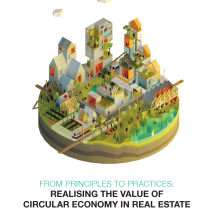
Arup has joined forces with the Ellen MacArthur Foundation to produce a report on the value of circular economyin real estate.
The circular economy offers real estate investors a framework for achieving environmental and social goals while delivering better economic performance. How do real estate business models need to change - apart from eco-design - if circular principles are to scale up in this sector?
The report defines five models to improve financial performance to the benefit of real estate investors and construction clients: