The UP Scorecard is a free, easy-to-use web-based tool which enables corporate procurement agents to assess the impacts of foodware and food packaging on human and environmental health.
It was developed by a cross-industry group of leading food service companies, NGOs and technical experts using life cycle assessment science. It conveys the information in an easy-to-use way and enables buyers to compare the merits of specific food containers.
The COM4PHA research project is working on developing new bioplastics for use in the packaging and agricultural sectors. The new formulations for packaging will be biodegradable and compostable, and the coating formulations will improve product quality and extend shelf life.
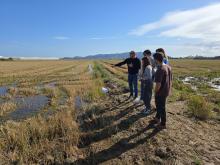
This workshop will look at nutrient recycling from aquaculture sludge, nutrient optimisation in fish feed, valorisation of nutrients in seafood processing and aquaculture nutrient flows. It will contribute to the United Nations (UNEP) project uPcycle, leading to a UNEP white paper on phosphorus sustainability in aquaculture.
IFAT Munich is the world’s leading trade fair for environmental technologies.
It is a solution platform, a networking event and a knowledge hub, and brings together the key international industry representatives from politics, business and science. Find out about cutting-edge solutions for water, recycling and circularity, with a strong focus on innovations with a global impact.
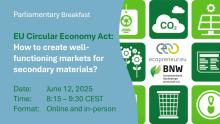
The European Sustainable Business Federation and the German Sustainable Business Association are organising a parliamentary breakfast hosted by Gerben-Jan Gerbrandy MEP to facilitate the dialogue between business and policymakers on how to develop the European market for recycled material.
The Forest Stewardship Council is committed to protecting healthy, resilient forests for everyone and forever.
With forests facing growing demand and pressure, they see the need to explore new solutions ensuring the best use and continuous circulation of forest-based fibres. This round table discussion will look at how this can be done.
This year, EU Green Week will focus on circular solutions for a competitive EU. It will explore how the EU economy can speed up the transition from linear to circular models of production and consumption.