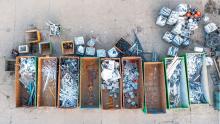
The network properties of the global waste trade were assessed using time series data of material and monetary flows between 2000 and 2022 from Chatham House's experimental database. The study focused on the distribution of monetary and material flows, policy recommendations and future research avenues useful for obtaining a more comprehensive understanding of socio-economic systems such as trade networks.
This work is a solid example of the application of network-based methods as an eco-mimicry approach for assessing the sustainability and fragility of socio-economic systems which can be helpful for researchers and policy makers interested in transitions towards regenerative circular economies.
Filippos K. Zisopoulos, Brian D. Fath, Susana Toboso-Chavero, Hao Huang, Daan Schraven, Benjamin Steuer, Alexandros Stefanakis, O.Grant Clark, Serban Scrieciu, Simron Singh, Dominik Noll, Martin de Jong
This study assesses the network properties of the global trade in waste metals and the distribution of material and monetary flows across trading countries using a bio-inspired approach.
Due to homogenization, high network redundancy and low network efficiency, the trade remained robust yet outside the "window of vitality" characterising natural ecosystems. A few, mostly high-income countries dominated the market, consolidating imports of high-value metal waste, mostly from low- and middle-income exporters.
Policies should address circularity and trade inequities, accounting for environmental and social ramifications throughout the lifecycle of products and materials.
Threads of Change is a new platform created by Humana People to People that highlights the transformative role of the second-hand clothing (SHC) industry in fostering sustainability, economic growth and social equity.
This initiative calls for supporting policies with a holistic perspective for a sector that is key to reducing environmental impact, creates green jobs along the global value chain, and contributes greatly to the EU’s GDP while minimising the use of scarce resources.
The platform's main aim is to spotlight the SHC industry's critical role in shaping a more sustainable textile sector. Help us build a case for an even more efficient and ambitious textile value chain by sharing your best practices or your views on the topic!
SustainableSolutionsMatch is the first cross-sectoral virtual event empowering European businesses on their path to a sustainable and circular economy. It brings solution seekers and providers together to tackle real challenges and find practical answers.
Whether you're looking for innovative ideas or reliable partners, this event brings solution seekers and providers together to tackle real challenges and find practical answers.
The Energy from Waste Conference 2025 will focus on decarbonising waste to energy, optimising resources - the essential business opportunity for the global waste-to-energy industry.
Participants will be able to meet with operators, project developers, investors, technology providers, waste authorities and government representatives and explore the role of waste to energy in circular economy development and the net zero transition.
The InvestCEC project is pioneering a replicable model driving the implementation of circular economy projects across European cities and regions.
Entrepreneurs and SMEs from across Europe are now invited to submit proposals for business cases that promote circular economy solutions, either in the city of Klagenfurt or in other European cities.
Go Circular 2025 will explore the significant changes taking place in the plastics industry, focusing on sustainable design, advanced recycling technologies, circular economy strategies, and policy and regulation.
RedGirraffe ESG Horizon is a software as a service solution designed for enterprise resource planning. It supports the circular economy by enabling precise tracking and optimisation of Scope 3 emissions across global supply chains.
RE-ZIP is an innovative, circular packaging solution designed to reduce waste in e-commerce. It provides reusable packaging options that replace traditional single-use packaging, helping e-commerce businesses lower their environmental impact.
The 2nd World Congress on Recycling and Waste Management will explore Leading the way in advanced recycling and waste management practices.
It will foster awareness and encourage sustainable practices promoting an eco-friendly environment, delving into advanced topics in recycling and waste management, with the participation of researchers, ecologists, environmental experts and professionals in chemical, civil and mechanical engineering, environmental science and recycling.