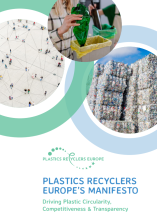
In a manifesto published in December 2023, Plastics Recyclers Europe argue the case for enhanced reycling of plastics in a loop which makes the best possible use of secondary raw materials.
The Horizon Europe project InvestCEC aims to develop a replicable model for implementing circular economy projects in cities and regions and so is calling for entrepreneurs to submit their projects.
Selected candidates will have the chance to present their circular economy solutions and receive detailed expert feedback from experienced business consultants, venture capital experts and the public sector at no cost.
The Nordic Working Group for Circular Economy is a working group under the auspices of the Nordic Council of Ministers. NCE's mandate includes contributing to activities and exchanges of information that will promote the transition to acircular economy in the Nordic Region.
NCE also wishes to influence the EU and global actors, for example by helping to identify solutions that will reduce consumption of raw materials, waste, emissions and energy by recycling products, including for new purposes.
NCE carries out projects on different topics related to the circular economy.
The 6th Plastics Recycling Technology Conference will be held in Vienna, Austria on 1 and 2 October 2024.
Responding to increasing pressure to recycle plastics and add value to reclaimed materials, the plastics industry is changing fast: this event will cover everything stakeholders need to know to stay abreast.
The conference will explore plastics recycling, advances in processes, feedstock security and all the latest technologies. It will also offer inspirational talks and discussion groups, so participants will learn about methods for improving the quality of reclaimed materials for higher-value applications and developments in recycling systems and additives for better end-of life processing.
This catalogue aims to provide waste management experts and decision makers in the Mediterranean region with an overview of successful practices, solutions and approaches in waste separation, collection, treatment and recycling in the Mediterranean.
It examines five projects spanning this region and covering issues such as employing a circular economy approach for the organic fraction of municipal solid waste management. It also highlights the lessons that should be considered when replicating successes and avoiding pitfalls.
As a growing community of European frontrunner festivals, Green Deal Circular Festivals strives for fully circular and climate neutral festivals, as festivals can play a guiding role in inspiring a green movement and accelerate society’s transition.
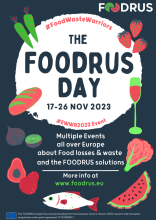
On 17–26 November 2023, the #FoodWasteWarriors campaign under the FOODRUS project hosts multiple events in various European countries. The diverse activities include stands at canteens in Brussels, a food upcycling meeting at the University of Copenhagen, a replication workshop in Hungary, and awareness campaigns in Spain, Denmark and Bulgaria.
The FOODRUS Day and all its events are part of the European Week of Waste Reduction 2023 (EWWR).
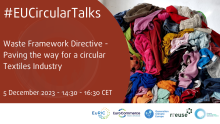
New waste management policies will change the way the EU handles textiles waste. The proposal for a new Waste Framework Directive aims to accelerate the development of the separate collection, sorting, reuse and recycling of textiles, in line with the EU Strategy for Sustainable and Circular Textile and the Circular Economy Action Plan.
On 5 December 2023 at 14:30 - 16:30 a discussion between stakeholders in the value chain will focus on how the sector sees the implementation of the Waste Framework Directive and the Extended Producer Responsibility for textiles in practice.
Since its inception, the EU Eco-Management and Audit Scheme (EMAS) has sought to be a tool to help companies reduce their environmental impact and gain acceptance in their area by being transparent about their environmental performance and maintaining an open dialogue with stakeholders.
But how can you involve staff in environmental management?
How are the EMAS tools helping to involve staff and top management in reducing environmental impacts and enhancing resource efficiency?
What good practices has EMAS identified for involving employees and stakeholders in its 30 years of experience?
Do people recognise the importance of their day-to-day behaviour in achieving environmental improvements at work and at home?
To answer these questions and have an interesting discussion with the audience, EMAS and ECESP organised a webinar on 26 October 2023, to learn more about EMAS and the importance of involving staff, top management and stakeholders in the circular transition.
While procurement can be an accelerator for circular economy in organisations, scaling up the positive outcomes of successful pilots can be difficult, due to specific internal agreements, culture and values (organisational attitude).
This third training session of the BRINC Network of Public Authorities will provide suggestions and advice on how to change and evolve governance structures (mindset, attitude, culture), to support the implementation of circular economy within your organization.