Report

  • Upload document

    Scrap steel at sea - How ship recycling can help decarbonise European steel production

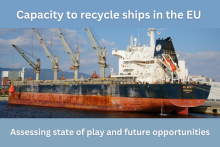
    "Scrap steel at sea: How ship recycling can help decarbonise European steel production - NGO Shipbreaking Platform, Sandbag - Smarter Climate Policy, University of Tuscia", with a photo of a rusting ship
    Type
    Author
    NGO Shipbreaking Platform
    Sandbag - Smarter Climate Policy
    University of Tuscia
    Publication Date
    11/2025
    Country
    Belgium
    Language for original content
    Scope

    This report looks at how scrap steel from the EU's increasing numbers of end-of-life ships can help decarbonise the European steel industry, strengthen industrial resilience, create green jobs, preserve and develop maritime skills and build a truly circular economy.

    The steel industry expects demand for scrap to rise due to calls for lower carbon footprints and the implementation of new steelmaking technologies. Ship recycling is a significant and largely untapped opportunity to meet this demand.

    Policies should support the development of safe and environmentally sound ship recycling, and stimulate material recovery and reuse. This will enable the EU to reduce dependence on imports, conserve valuable resources and advance toward climate neutrality.

  • Upload document

    Making the green premium work: Policy pathways for critical raw materials

    Making the green premium work: Policy pathways for critical raw materials: Policy pathways for critical raw materials - Edoardo Righetti, Vasileios Rizos, Deniz Tekin. CEPS in-depth analysis. November 2025
    Type
    Author
    Edoardo Righetti
    Vasileios Rizos
    Deniz Tekin
    Publication Date
    11/2025
    Country
    Belgium
    Language for original content
    Scope

    Greening metals and minerals production, including CRMs, comes with higher capital and operating costs – a 'green premium'. This reflects investment in decarbonising production processes, ensuring robust environmental and social safeguards and advancing circularity.

    Manufacturers appear hesitant to absorb such premia and a credible green-premium market for CRMs is unlikely to emerge without regulatory intervention.

    This analysis has laid out a phased, two-tier pathway towards a premium market. The first tier would focus on setting minimum market-access requirements, in order to level the playing field and exclude the worst performers from EU market access. A second tier of instruments is therefore needed to reward those who exceed baseline standards through targeted, conditional incentives.

  • Upload document

    Boosting circular transition: Insights from BioBoosters

    Boosting Circular Transition - Insights from BioBoosters. Edited by Anna Aalto -  Jamk University of Applied Sciences – Interreg Baltic Sea Region, co-funded by the European Union – Circular economy Bioboosters.
    Type
    Author
    Anna Aalto, Jamk University of Applied Sciences, Finland
    Laurynas Braškus, Sunrise Tech Park, Lithuania
    Svea Uusen, Pärnu County Development Centre, Estonia
    Lina Stanionytė, Sunrise Tech Park, Lithuania
    Artur Sobolewski, PRO CIVIS Foundation, Poland
    Magnus Persson, Paper Province, Sweden
    Eva Fridman, BioFuel Region, Sweden
    Malin Hildén, Paper Province, Sweden
    Katrin Kepp, Estonian University of Life Sciences, Estonia
    Inguna Kucina, Vidzeme Planning Region, Latvia
    Gudrun Mernitz, WITENO GmbH, Germany
    Małgorzata Olesiak, PRO CIVIS Foundation, Poland
    Per Myhrén, Paper Province, Sweden
    Publication Date
    11/2025
    Country
    Finland
    Language for original content
    Scope

    The BioBoosters hackathon model has brought together innovators who have come up with workable solutions for a wide range of challenges in the bioeconomy sector. The programme is coming to an end, and this report sets out how the project connected regional innovation systems across the Baltic Sea Region to a joint open innovation platform tackling business-driven circular transition challenges.

    It explores the relevance, efficiency, impact and sustainability of the hackathon model and the inter-regional cooperation dimension.

    The analysis is based on data and feedback from 18 challenge provider companies, nearly 100 mentored teams and over 500 connected industry and research specialists. It looks at what makes this hackathon model impactful and the added value of an international network.

  • BioBoosters Impact Review 2025 : Outlook on a Year of Innovation, Integration, and Interregional Impact. Edited by Heli Väliaho -  Jamk University of Applied Sciences – Interreg Baltic Sea Region, co-funded by the European Union – Circular economy Bioboosters.
    Type
    Author
    Anna Aalto, Jamk University of Applied Sciences, Finland
    Eva Fridman, BioFuel Region, Sweden
    Heli Väliaho, Jamk University of Applied Sciences, Finland
    Anna Gajek, PRO CIVIS Foundation, Poland
    Malin Hildén, Paper Province, Sweden
    Anni Hintikka, Jamk University of Applied Sciences, Finland
    Lili Veesaar, Estonian University of Life Sciences, Estonia
    Lina Stanionyte, Sunrise Tech Park, Lithuania
    Svea Uusen, Pärnu County Development Centre, Estonia
    Matti Räsänen, Jamk University of Applied Sciences
    Magnus Persson, Paper Province, Sweden
    Marta Riekstina, Vidzeme Planning Region, Latvia
    Ida Norberg, BioFuel Region, Sweden
    Rimas Meištininkas, UAB Toksika, Lithuania
    Per Myhrén, Paper Province, Sweden
    Damian Kuznowicz, PRO CIVIS Foundation, Poland
    Inguna Kucina, Vidzeme Planning Region, Latvia
    Katrin Kepp, Estonian University of Life Sciences, Estonia
    Moa Jonsson, BioFuel Region, Sweden
    Gudrun Mernitz, Witeno GmbH, Germany
    Publication Date
    11/2025
    Country
    Finland
    Language for original content
    Scope

    BioBoosters is a bioeconomy business accelerator. It runs a business-driven hackathon concept to boost the circular transition of the bioeconomy sector. 

    The hackathon concept is simple: identify a problem and bring innovators around the table to find a solution. For instance, hemp production in Estonia is flourishing – but the company growing it had no viable use for the stalks. The innovators explored options such as hemp-based filament for 3D printing, hemp as a substrate for mushroom cultivation for biodegradable packaging and extracting enzymes from hemp via fermentation-based processes.

    This report covers another eight hackathons, tackling logistics, wood, activated carbon, wine corks, soil health and apples. 

  • CGR The Value Gap:  Sweden – Assessing the value lost in the Swedish linear economy – Circle Economy, RISE, RE-SOURCE
    Type
    Author
    Carl Jensen (RISE), Andrew Keys (Circle Economy), Julie Lebreton (Circle Economy), Ann-Charlotte Mellquist (RISE), Megan Murdie (Circle Economy), Marc de Wit (Circle Economy), Peter Stigson (RISE)
    Publication Date
    11/2025
    Country
    Netherlands
    Language for original content
    Scope

    This report explores the links between circularity and economic value, offering a new perspective on how linear practices lead to economic inefficiencies.

    CGR has built up a huge body of data by mapping material flows, and this report uses that as a basis to look further and ask about the economic value of the materials we use, the products we consume and the systems we build—and where value is lost or not created.

    Current economic models leave substantial value untapped: resources are over-extracted, materials wasted, products underused, and social and economic opportunities missed. The report looks at value creation and loss in mining & extraction, manufacturing, agrifood, construction, mobility and consumables. It also explores the circular potential in each sector.

  • Upload document

    Circular transformation of industries: the art of scaling circular supply chains

    Front page of the report. Black background with neon blue lines going in a circle. The text reads: In collaboration with Bain & Company and University of Cambridge. Circular Transformation of Industries: The Art of Scaling Circular Supply Chains. White Paper November 2025. At the top right is the World Economic Forum logo.
    Type
    Author
    World Economic Forum
    Bain & Company
    University of Cambridge
    Publication Date
    11/2025
    Country
    Other
    Language for original content
    Scope

    Businesses across industries increasingly recognise circularity as a strategic lever for resilience, competitiveness and growth. Sourcing rare earths and other critical minerals is also becoming a geopolitical challenge, making the case for circular supply chains.

    The conversation has shifted from why circularity matters to how it can be implemented at scale. However, circular strategies are complex to operationalise, so companies require clear priorities, smart design and strong partnerships to overcome scaling challenges.

    This white paper outlines methods for prioritisation, approaches to design circular supply chains and key enablers that are essential for scale. It offers leaders actionable strategies to unlock economic value and accelerate circular transformation.

  • Upload document

    Municipal waste management

    Municipal waste management Despite gradual improvement, challenges remain for the  EU’s progress towards circularity - European Court of Auditors
    Type
    Author
    European Court of Auditors
    Publication Date
    11/2025
    Country
    Belgium
    Language for original content
    Key Area
    Scope

    This audit aimed to evaluate the action taken by the European Commission and the Member States with a view to achieving the EU’s objectives for municipal waste.

    It assessed whether the Commission’s legal initiatives and enforcement were fit for purpose; whether the four sampled Member States have made good progress in achieving EU waste targets and objectives; and whether the 16 sampled projects in these Member States – co-financed with EU funds – were implemented well in terms of time, cost and capacity.

    The audit covered the period from 2014 to 2024. It found that while the Commission has boosted targets and requirements, many Member States face challenges in their progress towards circularity, mainly due to financial constraints and weaknesses in planning and implementation.

  • Upload document

    Scaling up Europe’s bio-based industries

    Scaling up Europe’s bio-based industries, with the logos of the European Investment Bank and the European Commission
    Type
    Author
    EIB Group Advisory: Paulina Brzezicka, Sebastien Collot, Guy Hudson, Carmine Marzano
    Publication Date
    10/2025
    Country
    EU
    Language for original content
    Key Area
    Scope

    Scaling up bio-based industries can strengthen the EU’s strategic autonomy and competitiveness, foster innovation and create growth and jobs.

    The study focuses on three product classes within the bio-based industry that demonstrate significant potential for scaling up: (i) bio-based materials and chemicals, (ii) innovative food and feed ingredients and (iii) bio-based soil nutrients and enhancers.

    Key recommendations include leveraging Circular Bio-based Europe Joint Undertaking flagship grant applications to build a pipeline of promising projects, expanding the European Circular Bioeconomy Fund model to enable high-risk investment in early-stage bio-based ventures, and creating an eligibility checker for bioeconomy and circular economy projects.

  • Upload document

    Future availability of bio-based raw materials in Flanders

    Front page of the report with the Circular Flanders logo with images of a city, clouds, wind turbines, hills with a river. The text reads: Biogrondstoffen in Vlaanderen Scenariostudie
    Type
    Author
    Vlaanderen Circulair
    Technopolis BV
    VITO
    ILVO
    Publication Date
    10/2025
    Country
    Belgium
    Language for original content

    This report addresses the question of whether Flanders, with its limited space, will be able to produce enough biomass in the future to supply the bioeconomy and continue to feed the increasing population.

    Four scenarios were used, providing insight into the demand development for biobased raw materials for feed, food, fuel and fibre.

    It found that:

    • An open economy, with international imports/exports of bio-based raw materials, is crucial for a small, densely populated and prosperous region like Flanders.
    • Long-term collaboration with other regions and countries is a strategic necessity. The energy transition, protein shift and circular transition must be streamlined to run synergistically. This can reduce the pressure on raw bio-materials.

    The summary is in English.

  • Image of a woman's head and shoulders made up of images representing wind energy, water, transport, biodiversity. the text: "European Environment Agency - Europe′s environment 2025 - Main report - Europe′s environment and climate: knowledge for resilience, prosperity and sustainability - EEA Report"
    Type
    Author
    European Environment Agency (EEA)
    Publication Date
    09/2025
    Country
    EU
    Language for original content
    Scope

    Every five years, the European Environment Agency publishes a state of the environment report.

    The 2025 report stresses that climate change and environmental degradation pose a direct threat to Europe’s competitiveness, which depends on natural resources. Protecting natural resources, mitigating and adapting to climate change, and reducing pollution will build the resilience of vital societal functions that depend on nature, such as food security, drinking water and flood defences.

    We need to rethink the links between our economy and the natural environment, land, water and natural resources. The circular economy is part of this dynamic, and is addressed in chapter 4 on Managing the dynamic between our economy and our natural resources.