La Tête dans les Nuages gives a second chance to hot air balloons, advertising posters and polystyrene packaging, which would otherwise go to waste, by upcycling them into bean bags.
At the intersection of science, design, and waste management, PuriFungi develops natural cleaning systems. PuriFungi's new product is an ashtray made of mycelium and cigarette butts.
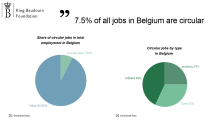
This report presents a baseline measurement of employment in the Belgian circular economy and provides insights into the nature and number of jobs in the country’s circular economy. This includes all jobs contributing to the circular economy through activities in renewable energy, repair and maintenance, recycling, digital technology, design, new business models and collaboration.
This report, conducted by the King Baudouin Foundation and the Dutch social enterprise Circle Economy, aims to inform governments, employers, social partners and other representatives with a view to pursuing effective and inclusive circular labour policy.
To prevent consumers from buying items they use only a few times a year, Usitoo enables customers to rent these instead. The cooperative has a catalogue of hundreds of items that its customers can rent with credit, thus making the possession span of these items much longer.
The Région Grand Est has five large cities (Metz, Mulhouse, Nancy, Reims and Strasbourg) and borders with Germany, Belgium, Luxembourg and Switzerland. It is the second largest industrial region in France.
Seven regional or circular-oriented organisations decided to join forces in order to set up a useful tool, promote their circular initiatives and bolster their expertise in this field. The result was plateforme collectif-grandest.org, which aims to bring all stakeholders together to develop a circular economy in Grand Est businesses.
It is a resource centre, with publications and a directory of circular businesses and initiatives. Members can join or create communities and access support when setting up a project. The platform also holds annual meetings.
IEEFC was established in 2014 and aims to promote a community of stakeholders (including public authorities and businesses) committed to the environmental, economic and social transition.
Its focus is the functional economy: encouraging people to buy the use of an item rather than the item itself. This approach limits the amount of resources needed to meet people's needs.
The Institute fosters cooperation between public and private stakeholders. It is active in knowledge sharing and awareness raising, organising workshops and visual aids. It encourages networking and acts as a discussion forum, with a network of clubs in France and two in Brazil.
It also has a library of publications on the functional economy.
The transition to a more circular economy is underway. But what can be done to speed it up? This report, authored by Institut Montaigne, recommends five principles that must drive circular economy policy:
focus on innovation
adopt a comprehensive, global approach
take into account differences between sectors and enhance public / private cooperation
To increase clarity in circular projects, France's standardisation body AFNOR developed a voluntary standard, XP X30-901, that proposes a common understanding, laying out the terms, principles and practices for all actors to agree to work with on the subject.
XP X30-901 proposes a 3 x 7 matrix covering the three dimensions of sustainable development - environment, economy, society - and the seven areas of action of the circular economy: sustainable procurement, ecodesign, industrial symbiosis, functional economy, responsible consumption, extension of service life, and the effective management of materials and products at the end of their life cycle.
In this report, six members of the standardisation commission share their experiences of this voluntary standard.
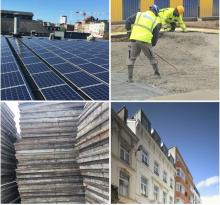
The Brussels Regional Programme for a Circular Economy (CE) is Belgium's capital region strategic effort towards a CE. Within this program, the Brussels construction industry with its 12,000 businesses is a priority sector. As construction and facilities management accounts for 98% of water use, 75% energy demand and 33% of waste in Brussels, there is great potential for a substantial contribution to a circular transition.
The roadmap, developed in partnership with the Environmental Agency through 3 stakeholder workshops, includes three gradual steps towards circular building in Brussels:
voluntary measures by construction businesses by 2025
comprehensive regulation for circular public buildings by 2030
reforming all relevant local planning regulations to include circularity by 2040.
Cycle Terre project aims to set up an industrial process to reuse soil extracted from the excavation sites of the new subway and other construction sites in Sevran, France.