In this first series of webinars, representatives of the European Investment Bank (EIB) will introduce the newly launched Circular City Centre (C3). This is a competence and resource centre hosted within the EIB and developed with the support from the European Investment Advisory Hub and the European Commission, in cooperation with Circle Economy.
C3 aims to support cities through sharing resources and practical information, providing circular city advisory and raising awareness about relevant financing and advisory opportunities for circular initiatives and projects.
The webinar series is aimed at city representatives and other stakeholders interested in fostering and accelerating the circular economy transition in cities, and is open to all who want to learn more about the different opportunities offered by the circular economy implemented in an urban context.
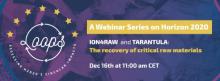
As the Horizon 2020 research programme becomes Horizon Europe, now is the time to see how great ideas have turned into real projects.
LOOPS is an opportunity to shine a spotlight on the cutting-edge research carried out and how it can change our communities. For those who are not familiar with it, LOOPS is a live webinar series committed to exploring innovation in the circular economy.
On 17 and 18 January 2022, the ECESP Coordination Groupwill present Europe's pioneering work done by its Leadership groups in the field of the circular economy before a global audience at the Circular Europe Days in Dubai.
Join MEPs Pietikäinen and Kuhnke, the European Environment Agency and the Finnish Innovation Fund Sitra on 12 January to discuss how to scale up and mainstream circular business models, in line with a sustainable product policy.
As the Horizon 2020 research programme becomes Horizon Europe, now is the time to see how great ideas have turned into real projects.
LOOPS is an opportunity to shine a spotlight on the cutting-edge research carried out and how it can change our communities. For those who are not familiar with it, LOOPS is a live webinar series committed to exploring innovation in the circular economy.
Since 2020 the European Institute of Innovation and Technology (EIT) Circular Economy Community has been engaging with civil society, EU and international stakeholders as well as the EIT network by supporting actions to strengthen and optimise the transition towards a more circular and innovative future.
Join this webinar on 17 December to find out more about EIT's work on the ground and hear the stories of involved actors working with EIT to increase the uptake of circular innovative solutions. Participants will get the opportunity to interact with the panel of experts and find out more about opportunities coming from the EIT Circular Economy Community programme.
EU Commissioner Virginijus Sinkevičius will join RREUSE to explore the meaning of social value in the circular economyand whether social dynamics have been inherent factors in developing EU policies related to the green transition.
The webinar on 17 December 2021 will also focus on the way forward in ensuring that tools such as the Social Economy Action Plan and the Circular Economy Action Plan work together to create a more favourable policy and funding environment for social enterprises, safeguarding a socially fair and inclusive circular transition.
As the Horizon 2020 research programme becomes Horizon Europe, now is the time to see how great ideas have turned into real projects.
LOOPS is an opportunity to shine a spotlight on the cutting-edge research carried out and how it can change our communities. For those who are not familiar with it, LOOPS is a live webinar series committed to exploring innovation in the circular economy.
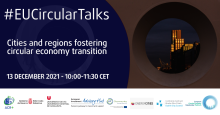
The transition to a circular economy entails the systemic transformation of entire value chains, covering design, production and consumption. Cities and regions are hubs of innovation and socio-economic transformation, with great potential to lead the transition to a circular economy. However, such a deep transformation often requires supporting mechanisms to make it happen.
ACR+, EIB Advisory Hub, the European Commission, the Government of Navarra, the Interreg MED Green Growth community, EIT Raw Materials, Dublin city, EUCF and the ECESP invite you to attend this #EUCircularTalks to discuss how different supporting initiatives are being used by cities and regions in their transition towards a circular economy. The talk will take place on 13 December at 10:00-11:30 CET.
The 2nd International Conference on Strategies towards Green Deal Implementation – Water, Raw Materials & Energy (ICGreenDeal2021) - aims to present the issue of climate change and ways to prevent it with innovative solutions (technological, environmental, economic, and social) that can be implemented under the Green Deal Strategies.
This online conference on 8-10 December 2021 is the continuation of the 1st International Conference on Strategies towards Green Deal Implementation – Water and Raw Materials, a very successful event with almost 500 participants.