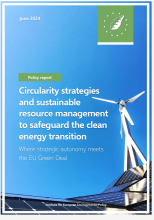
This report summarises the essential results from reports on the biodiversity/circular economy nexus prepared by members of the ECESP's Leadership Group on Biodiversity and Climate.
Its main premise is that biodiversity loss is not only an essential problem for our societies and human well-being but also a key business risk. The report argues that while the circular economy is a key tool for advancing towards our environmental targets, its implementation must be centred around biodiversity and climate considerations.
Reducing the demand for primary resources and preventing waste and pollution at product design stage are crucial, as are policies and measures to promote biodiversity protection and restoration.
On behalf of the Consumer Information Programme of theOne Planet Network(OPN) and the EcoAdvance project, the United Nations Environment Programme is pleased to announce a new call for proposals.
This initiative seeks to enhance the adoption of ecolabels and foster sustainable and circular public procurement as key strategies for advancing climate mitigation, biodiversity conservation and resource protection within the building and construction sector.
This call for proposals is designed to empower projects in developing countries and emerging economies that are contributing to sustainable and circular practices in the building and construction industry.
This online workshop on 23 April will focus on the certification scheme for the implementation and monitoring of the waste management system using cold chain traceability and PAYT (Pay-As-You-Throw) schemes.
It is organised by the University of Copenhagen as part of the FOODRUS project, which aims to prevent food loss and waste and promote resource efficiency across the agri-food value chain.
Electronics Goes Green 2024 is a conference geared to the growing global community of scientists, product developers, business managers and policymakers working on environmentally benign processes, products, systems and business models in and for the electronics and ICT industry.
This guide is intended primarily for building owners. It presents several pathways for integrating the principles of reusing building materials in construction and renovation projects.
During this event in Rotterdam on 10 June, guest speakers Brian Fath, Michael Roos, Katy Gillespie and Şerban Scrieciu will introduce the audience to alternative economic theories, and how these can play a pivotal role in addressing the complex challenges of the Anthropocene era.
This free event is organised by the Erasmus University Rotterdam initiative Dynamics of Inclusive Prosperity, in collaboration with the Interdisciplinary Climate Economics for Nature and Society - ICENS lab.
Platform business models, exemplified by companies like Amazon, have disrupted industries and achieved global scale. This session on 17 April will discuss how these models, typically serving linear economies, can also promote circular and collaborative business models.
Participants will be able to explore how circular platforms, influenced by policies, technologies and trends, can drive the circular economy’s growth.