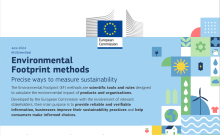
Check out the new Environmental Footprint (EF) methods webpage and factsheet!
The EF methods are scientific tools and rules designed to calculate the environmental impact of products and organisations. Find out how businesses and consumers can benefit from them and see how they can be applied to a product.
The European Commission has published the guidance on the application of the 'do no significant harm' (DNSH) principle under the Social Climate Fund. The guidance covers the environmental safeguards that must be in place to benefit from the Social Climate Fund (over EUR 80 billion as from 2026).
The consultation closes on 13 August. A webinar will take place on 18 July to explain and clarify the criteria included in the DNSH guidance and allow stakeholders to ask questions.
BIOEAST has issued a Stakeholder Manifesto on “Sustainable supply chains and strengthened local processing of bioresources in Central and Eastern Europe”. They are calling for signatures from individuals and organisations, both within the Central-Eastern Europe macro-region and beyond.
The Irish Government has just signed a framework agreement for the procurement of around 60 thousand remanufactured laptops, meaning that any public body can purchase some of these laptops through it. It's the first time that an EU Member State has implemented this type of GPP procedure.
The Horizon Europe project Hubs4Circularity Community of Practice is organising a workshop to discuss and reflect on the various funding and financing approaches relevant to the industrial-urban symbiosis community.
TwinRevolution is a European project working on developing a training curriculum to facilitate the implementation of the twin transition in manufacturing industries. Their webinar will be an opportunity to share insights on the state of play of the twin transition economy in the furniture and textile sectors.
The 6th European Recycling Conference, organised by EuRIC in partnership with Assofermet, will take place on 26 September in Milan, under the heading 'Recycling Today, Resourcing Tomorrow'. This event will also celebrate EuRIC's 10th anniversary: a decade of commitment to circularity and sustainable recycling practices.
Organisations using the mark are required to submit their calculations and observations, providing a database of 11 projects to date, which has been analysed to identify patterns of adoption. OFRA has now issued a report on their findings.
In practice:
The minimum second life furniture percentage was 60%.
All projects would have been able to achieve cost savings on a like-for-like basis.
All projects are attractive; no compromise in aesthetics was reported or observed.