A coalition of European cities has published a policy brief calling on EU institutions to strengthen the enabling framework for local circular economy implementation. The Circular Cities Frontrunner Group, consisting of cities such as Amsterdam, Milan, Malmö, Copenhagen, Turku and Porto, has developed the brief as a shared contribution to the EU’s 2024-2029 political cycle.
The policy brief builds on a joint open letter addressed to Members of the European Parliament in late 2024 and outlines how cities can help scale the circular transition - if the right policy conditions are in place.
The brief contributes to ongoing discussions around the Circular Economy Act, the EU’s competitiveness agenda and the future of multilevel governance.
Circular Week is an international series of events and initiatives dedicated to the circular economy and sustainable development, taking place across Europe.
It aims to promote the concept of a closed-loop economy, support sustainable business models and foster collaboration among stakeholders.
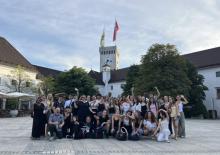
For the fourth year in a row, Ljubljana welcomed students from across Europe to co-create circular solutions in the heart of Slovenia. From 30 June to 4 July, 40 students took part in the Ecotopia Summer School, a programme which focuses on the circular economy through hands-on learning, collaboration and real-world application.
SOPHIA is an EU-funded Horizon Europe project that aims to implement advanced digital solutions in end-of-life solar panels, involving the full value chain in order to increase their current reuse, repair and recycling rates. The end goal is to foster a more circular, innovative and competitive Europe.
THE LIFE BIOBEST project aims to guide the mainstreaming of best bio-waste management and recycling practices, with a view to enriching depleted soil with high quality compost.
Its Comprehensive Guidance sets out key policy recommendations to strengthen the EU legal framework for bio-waste management. Drawing from extensive research and stakeholder consultation, it outlines three interconnected areas for improvement: boosting effective models for separate collection and recycling, promoting reliable markets for compost and digestate, and enhancing monitoring and enforcement of bio-waste regulations.
It provides policy measures to help close the gap between current practices and potential capture rates, addressing the fact that only 26% of kitchen waste is collected separately in the EU.
The annual Circular Economy Insights Series helps shape strategies and informs the development of support for communities of practice across Ireland. It highlights research gaps and will guide work in this area.
The 2025 report is designed to support an evidenced-based approach to public engagement and communications for a circular economy. It integrates best practices, targeted market research, socio-demographic analyses and community initiatives to provide key insights and statistical evidence on the specific trends currently driving circular economy behaviour in Ireland.
It aims to strengthen capacity for high-quality communications and public engagement to ensure that Ireland is informed and enabled to participate in, and benefit from, the circular transition.
The ECESP Leadership Group on Textiles organised the #EUCircularTalks event on Circular textile policies: implementation, challenges and the role of the Circular Economy Act.
This webinar aimed to assess the state of play of circular textile policies in the EU, examining progress made, existing gaps and next steps.
This session will explore the impacts of the EU's “clean, competitive and circular” policies on communities, including indigenous peoples and young people, and consider how to foster intergenerational equity and participation, starting from the raw materials agenda.
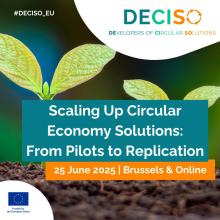
This workshop will discuss the future of the DECISO pilot projects, diving into the business models that have been built around them, and explore pathways for scaling up successful circular economy solutions in similar contexts.
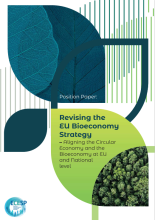
As the EU seeks to advance its transition towards circular economy, civil society organisations – backed by academic insights – are calling for a bioeconomy strategy that places sustainability, environmental resilience and social well-being on an equal footing.
This paper provides a multi-actor perspective to the challenges involved, focusing on sustainability, economic development (especially in rural areas) and regulatory frameworks. It highlights gaps in the existing strategy and proposes policy recommendations for policymakers and research institutions.