This session will present the findings of innovative demonstration projects on net zero emission and plus energy neighbourhoods around Europe, as well as the viewpoints of key stakeholders along the value chain. It will also explore the policy measures needed to finance and scale up such projects around Europe.
The main outcome will be a list of policy recommendations for private and public decision makers.
The European Commission has announced a EUR 40 million investment in the SWITCH to Circular Economy in East and Southern Africa (SWITCH-2-CE in ESA) programme.
This programme aims to advance circularity in Eastern and Southern African countries as they shift from a linear to a circular economy. It will do so by creating an enabling environment for investment in circular business models and improving access to the necessary skills and finance.
The CEE2ACT project aims to empower Central and Eastern European countries to develop circular bioeconomy strategies. It has National Bioeconomy Hubs established in 10 countries across the EU.
It'll be holding the second webinar in its Knowledge Transfer series on 27 June.
The Waste Framework Directive mandates that from 2025, EU Member States must establish separate collection systems for used textiles.
This briefing provides an overview of the state of play of textile waste generation, collection systems, treatment capacity and the different classifications for used textiles in Europe. It also identifies factors which must be considered when implementing separate collection systems, with a view to fostering the circularity of textiles without inadvertently increasing exports, incineration or landfilling.
It is underpinned by a report from the European Environment Agency’s European Topic Centre on Circular Economy and Resource Use.
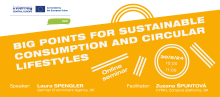
From Niche to Centre (City Centres as Places of Circular Lifestyles) is an Interreg Central Europe project. It aims to revitalise fading city centres by making local trade and consumption more circular and sustainable.
The project is organising a series of webinars: this one will explore Big Points for Sustainable Consumption and Circular Lifestyles. It will identify measures that are particularly important for effective environmental and climate protection.
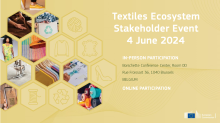
The Textiles ecosystem stakeholder event, organised by the European Commission’s Directorate-General for Internal Market, Industry, Entrepreneurship & SMEs, will take place on 4 June.
There will be updates from the Commission on the EU Strategy for Sustainable and Circular Textiles, the implementation of the Transition Pathway for the Textiles Ecosystem, the EU Pact for Skills and the European Partnership on Textiles under Horizon Europe.
EU Green Week is an annual opportunity to raise awareness, promote and discuss European environmental policy. This year's focus is Towards a water resilient Europe.
There are two strands: the EU Green Week conference Towards a water resilient Europe, taking place on 29-30 May in Brussels, and the EU Green Week Partner Events, taking place between 29 May and 1 September around Europe. They will focus on water resilience, but there are several on circularity, too - such as Implementing circular economy with EU Ecolabel, taking place on 27 August in Latvia.
Let's Reduce Consumer Food Waste! Solutions from the European Consumer Food Waste Forum will take place on 5 June in Brussels.
This event is organised by the European Commission's Directorate-General for Health and Food Safety and the Joint Research Centre. It is intended for local, regional and national level policy makers, food businesses and other organisations and educational establishments committed to tackling consumer food waste.
EFPIA, the European Federation of Pharmaceutical Industries and Associations, supports the principles of the Circular Economy Action Plan.
In the healthcare industry, circular opportunities could be centred around eco-design of products, packaging & devices, and end of life; circulation of products and materials to maximise the value of resources; reduction of reliance on single-use plastics, regeneration of natural systems by preserving finite materials and exploring renewable resources and associated services; suppliers and customer engagement for equipment return.
Safe and sustainable closed-loop recycling within the industry is the goal, but where this is not yet feasible, these valuable materials must be circulated as secondary raw materials for other sectors.
Flexible packaging provides lightweight, efficient protection for various products. Given just how important it is to recycle packaging, FEICA has published a report taking stock of how laminating adhesives meet design-for-recycling guidelines and how sortability and recyclability testing relate to flexible plastic packaging.
Highlights:
What are laminating adhesives and why are they important for plastic packaging?
What are the challenges and criteria for recycling flexible plastic packaging?
How are laminating adhesives reflected in design-for-recyclingguidelines and what are the sortability and recyclability test methods for flexible plastic packaging?
How to enhance recyclability for adhesive applications, and future prospects.