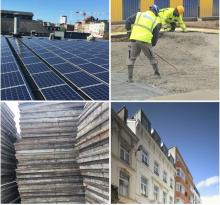
The Brussels Regional Programme for a Circular Economy (CE) is Belgium's capital region strategic effort towards a CE. Within this program, the Brussels construction industry with its 12,000 businesses is a priority sector. As construction and facilities management accounts for 98% of water use, 75% energy demand and 33% of waste in Brussels, there is great potential for a substantial contribution to a circular transition.
The roadmap, developed in partnership with the Environmental Agency through 3 stakeholder workshops, includes three gradual steps towards circular building in Brussels:
voluntary measures by construction businesses by 2025
comprehensive regulation for circular public buildings by 2030
reforming all relevant local planning regulations to include circularity by 2040.
With FarmacoAmico, CiboAmico and Cambia il Finale, the HERA has moved beyond its core business to actively prevent medicines, food and bulky goods from becoming waste.
The Urban Agenda Partnership on Circular Economy has identified several barriers and bottlenecks regarding the use of secondary raw materials (recycling) or products (re-use) originating from waste streams and has now commissioned a basic assessment of the current legislative framework, the implementation and application of that framework, and the definitions of waste in the context of a circular economy.
Are you an urban waste manager or regulator? Share your experiences and best practice to provide valuable feedback on implementing waste legislation and contribute to recommendations seeking to improve this framework.
REDEL is an energy provider in Italy. Its activities comprise decommissioning outdated energy installations. The PVC Upcycling project aims to initiate a circular model for reclaiming resources by:
de-manufacturing: recovering the PVC of electric cables coming from decommissioned energy plants;
re-manufacturing: recycling of the same PVC in products.
Inaugurated in 2016, Mater-Biotech is the first world industrial plant for the production of 1.4 bio-butanediol (BDO) directly from sugars, paving the way for the production of new chemical intermediates from renewable sources. The plant was designed to reuse the by-products for its energy needs, thus optimizing the life cycle of the entire process.
In view of the environmental, economic and social challenges facing our current society, the Walloon Brabant region is determined to offer a space for balanced discussions, guidelines and for helping make the right decisions, to be taken today to preserve the generations of tomorrow. In order to encourage exemplary initiatives, raise awareness and encourage people to adopt good practices, Walloon Brabant organises Trophées Incidences 2019 for businesses, farmers, associations, individuals and public services.
The SCREEN Final Conference was held in Rome on 18 and 19 October 2018, during the two-day Forum CompraVerde (BuyGreen), in order to present the results of the SCREEN project.