The 2024 ASEAN Circular Economy Forum (ACEF2024) will focus on Guiding the Transition – ASEAN and EU Approaches to Circular Innovation and Entrepreneurship.
The Forum aims to support innovation and entrepreneurship for a circular transition, showcase existing circular economy practices in the ASEAN region and build on ASEAN's traditions and values for a circular transition.
The European Sustainability Congress 2024 is one of the biggest international events focusing on the circular economy and sustainable development.
It aims to promote the idea of the circular economy, support sustainable business models and establish cooperation between interested stakeholders. The Congress will be the focal point of Circular Week 2024 and is organised by INNOWO - Institute for Innovation and Responsible Development and Polish Circular Hotspot, in cooperation with the European Circular Economy Stakeholder Platform.
ETRA, the European Tyre Recycling Association, and AIMPLAS, the Plastics Technology Centre, are organising an international workshop exploring rubber recycling, polymer technology and EU-funded projects.
It will address various challenges in the elastomeric materials sector by providing a dynamic platform for sharing knowledge and exploring opportunities. There will be a pitch session, where experts will consider each participant's project, and sessions on issues such as Market analysis: challenges, opportunities and limits in the recycled rubber industry.
This publication describes a wide range of Spanish businesses which are run on circular principles. The goal is to encourage the shift to a circular economy.
BUILD UP, the European portal for energy efficiency and renewable energy in buildings, is hosting the fourth in a series of six webinars organised with the CircularB COST Action project. This one will focus on Building Design Teams and Building Users, Facility Managers and Owners.
This strategic plan is about making the circular economy in Wales a reality.
The Welsh Government set out their commitment to use the powers and levers available to them to accelerate the transition to a circular, low-carbon economy. Wales is already doing well in terms of recycling, but further efforts are needed. The strategy recognises that resource use is key, and states that a circular economy is a critical element of a green and just recovery because it will reduce consumption and prevent waste.
The strategy lists 8 headline actions for delivering a circular economy in Wales, from helping Welsh businesses reduce their carbon footprint by becoming more resource efficient to phasing out unnecessary single-use items, especially plastic.
Wales (Cymru in Welsh) will be hosting the 2024 European Circular Economy Hotspot: Circular Economy Hotspot Cymru in Cardiff on 7 - 9 October.
This summit will be an opportunity to find out about Wales' circular economy achievements and aspirations, and learn about circular economy solutions from the public sector, private sector and communities from Wales and beyond. Participants will be able to engage with Welsh projects across industry, business, public bodies, academia, and towns and cities.
There will be global circular economy innovators, leaders and thinkers, so it's a good chance to forge links and network.
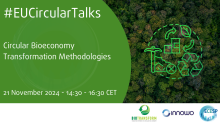
The transition towards a circular bioeconomy is crucial for meeting the goals of the European Green Deal and the Circular Economy Action Plan and for tackling the climate and biodiversity crises.
Following on from COP16 on Biological Diversity and on the same day that delegates will be discussing nature and biodiversity at COP29 on Climate Change in Azerbaijan, the ECESP Leadership Group on Circular Bioeconomy invites you to join the #EUCircularTalks on Circular Bioeconomy Transformation Methodologies.
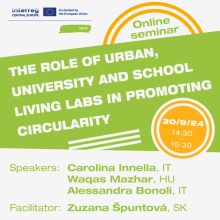
This online seminar on the role of urban, university and school Living Labs in promoting circularity is part of the From Niche to Centre - City Centres as Places of Circular Lifestyles (NiCE) project.
The circular economy is increasingly coming to be recognised as necessary - but more needs to be done to get the general public on board. Living Labs can help here.
CEWEP, the Confederation of European Waste-to-Energy Plants, will be holding its international conference on residues from waste-to-energy on 25 September in Mechelen, Belgium. Residue experts from across Europe will tackle topics such as environmental contribution, residue utilisation and material recovery.
There will be ample opportunity for networking during the breaks and the buffet on the evening of 25 September. On 26 September, participants can visit Indaver’s ash treatment facility.