Stakeholders in the food waste reduction network REGAL Normandie will celebrate their 10th anniversary with plenary sessions and workshops looking at what has already been done to cut food waste and exploring what can be done to push on with this vital initiative.
On 5 September, ZeroW will be holding a workshop bringing together a diverse group of stakeholders, research institutions, startups, industry associations, regulatory authorities and more. They will discuss how to market innovative food loss and waste solutions produced during the research and development stage of EU projects.
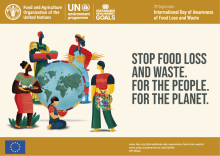
This year, the International Day of Awareness of Food Loss and Waste will be celebrated on 27 September. Get involved in the campaign by sharing free materials on digital channels and spread the word!
You are invited to join the global virtual event convened by FAO and UNEP on Friday 27 September at 13:30 - 15:00 CEST in observance of the fifth International Day of Awareness of Food Loss and Waste.
Resourceful Cities was an URBACT Action Planning Network of nine European cities. The project sought to develop the next generation of urban resource centres. These resource centres see waste as a source of raw materials, thus acting as catalysts for the local circular economy.
The EU-funded 3R Connect project has established a common roadmap based on the existing strategies of the regions of Flanders, Greater Copenhagen and Northern Portugal. The goal is to accelerate circular transformation within the plastics, textiles and construction sectors.
The completed project has produced three comprehensive Joint Action Plans for Circular Economy in Plastics, Construction, and Textiles. These action plans are the culmination of an initiative that pooled input from over 200 private, public and research actors. Through their collective expertise, 3R Connect identified actionable strategies to accelerate the transition to a circular economy in Europe.
The action plans can be used by other regions: for instance, they can identify partners and join specific actions.
The CIRCit research project aimed to help Nordic industry learn about and implement circular opportunities by developing, testing and implementing science-based tools.
It focused on six areas, and produced workbooks setting out tools and guidelines for the transition to a circular economy.
Nordic Circular Arena is a digital gathering place for circularity professionals in the Nordic countries.
It is a freely accessible online platform, hosted by Nordic Circular Hotspot and co-funded by Nordic Innovation, and the first digital multi-stakeholder platform for the circular transition in the Nordic region.
Through the Arena, you can:
get and share circular information, knowledge and intelligence
find others working on circularity in your region and beyond
access circular economy projects and opportunities, reports and resources, networks, companies and organisations, events and much more.
Participants can get involved in the circular transition by taking part in discussions, sharing their ideas, opportunities and information, and forging new circular connections.
This year, the Nordic Circular Summit will take place in Helsinki, Finland and online on 18-19 November. It will be focusing on the enterprise of circular economy. Can entrepreneurs and startups close the Nordic circular economy gaps? Come and find out!
Bio4HUMAN is a Horizon Europe-funded initiative working to solve solid waste management challenges in humanitarian settings.
This September, it will be holding a webinar on empowering the bio-based sector for solid waste management in humanitarian settings. The webinar will focus on the findings of their Humanitarian Needs Assessment Report and familiarise bio-based stakeholders with humanitarian settings and the challenges facing them in terms of solid waste management.