To mark its 30th anniversary, the Association of Cities and Regions for sustainable Resource management (ACR+) is delighted to announce that it is launching a photo contest on "Capturing Circularities in Cities and Regions".
The circular economy is a powerful tool which cities and towns can use to tackle climate change, reduce CO2 emissions and regenerate nature. Join this online WCEF accelerator session on 17 April to learn how European cities are harnessing circular practices to achieve climate goals and nature restoration in urban settings.
InvestCEC, working with the DEFINITE-CCRI project as part of the CCRI initiative, is hosting a webinar on "Empowering entrepreneurs for investment success". It will take place on 11 April and aims to enable entrepreneurs to overcome funding challenges and attract investments in the circular economy.
This is an official side event of the World Circular Economy Forum.
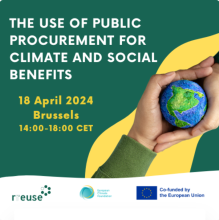
Join RREUSE, Europe’s largest network of social enterprises active in reuse, repair and recycling, for a deep dive into the opportunities and challenges of public procurement as a way to advance climate and social goals.
This half-day conference on 18 April, followed by a chance to network, will bring together EU policy makers, public procurement practitioners and experts, representatives of social enterprises, their networks and Brussels-based NGOs.
The event will also be an opportunity to present RREUSE's report "Advancing climate, environmental and social goals through public procurement".
With the 9 Ilhas Circulares website, the Portuguese public authorities aim to promote a more sustainable lifestyle on the Azores islands.
It is a collaborative online space for exchanging or selling surplus materials, secondhand items and circular services.
This online marketplace has 525 registered users. It fosters a culture of sharing among community members and facilitates donations, with a focus on supporting those in need. In addition to showing products to buy or sell, the platform offers access to a variety of repair, recycling and upcycling services. It has a section on good practices and a space for promoting companies and entities with a sustainable business model.
The circular economy has become a key part of the sustainable transformation of regions. The German Federal Institute for Research on Building, Urban Affairs and Spatial Development on behalf of the Federal Ministry for Housing, Urban Development and Building is leading the new Territorial Agenda pilot project. This scheme supports the development and implementation of strategic circular economy concepts in rural areas in Germany and Europe.
The pilot project is now establishing a partnership, and a call for funding for four German regions is ongoing. European regions and organisations are invited to declare their interest in joining the partnership.
In December 2021 the Commission adopted a revised Recommendation on the use of Environmental Footprint methods, helping companies calculate their environmental performance based on reliable, verifiable and comparable information. The 2nd public consultation on the Product Environmental Footprint Category Rules for apparel and footwear is now live and will be open until 28 April 2024.
Ms Ettinger is a lawyer in Germany and holds a Master of Law degree from George Mason University (USA). Before joining EuRIC, she worked at a Brussels-based consultancy, advising multinational companies on environmental, health and safety matters.
EuRIC is a confederation which represents the interests of European recycling industries within the EU. It spans the majority of waste streams, and so can facilitate cooperation between national recycling and resource management federations and companies from over 23 European countries, operating both locally and globally.
EuRIC represents:
5 500+ companies generating an aggregated annual turnover of about €95 billion, including large companies and SMEs involved in the recycling of and trade in various resource streams
300 000 local jobs which cannot be outsourced to non-EU countries
a million tons of waste recycled each year (metals, paper, glass, plastics, WEEE, ELVs, tyres, textiles, construction & demolition, etc.).
By turning waste into resources, recycling loops recycled materials back into value chains. Recyclers play a key role in bridging resource efficiency, climate change policy and the industrial transition.
The European Commission is calling on European cities committed to sustainability to apply for the 2026 European Green Capital and Green Leaf Awards. The call for applications is open until 30 April 2024.