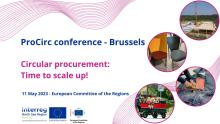
In the conference "Circular Procurement: time to scale up!" in Brussels on 11 May 2023, the Interreg ProCirc partners invite public and private procurers, circular procurement experts, (sustainability) managers from procuring organisations, value chain representatives, and national and EU policy makers on Circular Economy and Procurement to learn from their experience, and together explore how to scale up. Throughout the day there is ample opportunity to meet, discuss, and share thoughts on circular opportunities and challenges.
The focus of this online event on 18 April is on what the Interreg NSR ProCirc project partners have learned and developed in circular procurement. The event will start with a plenary session in English and the participants will then dive into the results in three breakout sessions in different national languages:
From one circular pilot to circular economy on everybody’s lips
Setting goals & monitoring: how to measure impact
How to scale adoption through Joint Statements of Demand
The Economic Cooperation and Trade Division of UNECE organises an online and in-person event titled "Regional Policy Dialogue: Sustainable and Innovation-Enhancing Public Procurement to support Circular Economy Transition in the UNECE region" on 15 November (8:00-9:45 CET), which will also contribute to the development of a policy brief on Sustainable and Innovation-Enhancing Public Procurement.
This report, prepared by the Dutch Ministry of Infrastructure and Water Management, provides an analysis of the Dutch procurement system.
The Dutch Sustainable Public Procurement (SPP) approach embraces six themes, two of which are explored in this study: climate-neutral procurement and circular procurement. Included in these two themes are aspects such as CO2 and other greenhouse gas emissions, as well as the reuse of raw materials at the highest possible level of value.
SPP is a highly topical issue for a steadily growing number of organisations in the Netherlands: action plans are being written, requirements and criteria are being formulated, and tools are being produced. Together, these activities are creating growing demand for instruments that evidence the impact of SPP.
This book provides answers on how to govern the transition to a circular economy in different socio-cultural and political contexts.
It is intended to help the global changemakers who are building our circular future. Author Jacqueline Cramer spoke with 20 representatives of circular hotspots worldwide, thoroughly analysed their different contexts and extracted 10 key takeaways. Everyone working on circular initiatives can use these and adapt them to their own socio-cultural and political contexts.
In this book, Jacqueline Cramer shows how network governance can power the circular economy. Network governance is about building a coalition of partners, which all fulfill a specific function in the network and are aligned by so-called transition brokers. By complementing conventional, public governance with this new form of governance, the best of both worlds is created.
Prof. Cramer shares her huge experience of implementing numerous circular initiatives in the Netherlands. As a practitioner and scholar, she has identified ten guiding principles for building circular initiatives, based on network governance. These guidelines can support everyone who wants to start or expedite a circular initiative.
This workshop used the concrete example of procurement of charging stations for electrical vehicles to link circular procurement to the energy transition.
The idea for a new Leadership Group specifically on Circular Procurement started during the ECESP Annual Event in 2020. Twenty-two organisations decided to harness the enormous potential of procurement to accelerate the circular economy in Europe. This outcome document focuses on the Sustainable Products Initiative and mandatory requirements as a driver of the CEAP.
The Sustainable Procurement Platform is managed by ICLEI Local Governments for Sustainability. It provides up-to-date news, case studies, events and guidance on sustainable procurement from across the world.
Its focus is sustainable and circular procurement. Circular procurement involves considering the whole lifecycle of products throughout their supply chain and ensuring that the products and services acquired generate benefits not only for the buyer, but also for the environment, society and the economy.
The platform showcases replicable sustainable, circular and innovation procurement approaches and strategies. Its resource centre contains over 200 case studies setting out the methods used, the obstacles overcome and successes achieved in implementing sustainable public procurement.