La transition vers une économie plus circulaire ne peut se faire sans un changement de perception de la valeur économique des déchets. Considéré non plus comme une contrainte et une charge de fonctionnement pour l’entreprise mais comme une source génératrice de valeur, le déchet peut se voir attribuer une valeur économique positive.
La technologie blockchain peut être utilisée pour accélérer ce changement de valorisation, favoriser la réutilisation et le recyclage des déchets, en renforçant la traçabilité sur toute la chaine de valeur. L’attribution d’une identité numérique unique aux déchets et aux ressources naturelles, garantir la provenance de l'énergie, ou encore fiabiliser la comptabilité carbone sont autant d’éléments permettant de favoriser la transition vers une circularité de notre économie.
Le 13 décembre, la Fédération française des professionnels de la blockchain vous invite à découvrir un rapport mettant en lumière les opportunités offertes aux acteurs de l'économie circulaire par la technologie Blockchain, encore trop sous-estimées à ce jour.
The European Cluster Collaboration Platform (ECCP) is an online hub.
It aims to strengthen the competitiveness and sustainability of Europe’s industrial ecosystems, particularly SMEs, improving their performance in terms of productivity, innovation, internationalisation and resource efficiency through a variety of modern tools:
Events to foster capacity building and peer discussions
Matchmaking events
A knowledge database mapping regional, national, international and sectoral cluster networks, toolkits and publications
Partner search and exchange facilities to link up offer and demand
Support for international cooperation
Their Green Transition Support Hub, with a network of institutions offering support for resource and energy efficiency, addresses circularity.
The Czech Circular Hotspot is operated by the Institute for Circular Economy (INCIEN), a non-governmental organisation that has been promoting circular economy principles since 2014.
CCH aims to facilitate cross-sectoral and international cooperation in the field of the circular economy. It wants to create a space where the public and private sector can cooperate to accelerate the transition towards a circular economy in Czechia.
The hotspot was set up in 2022, and thanks to strong partners and successful models abroad, it has rapidly grown into an effective network. Members include businesses, SMEs, start-ups, NGOs and academic bodies.
As well as networking opportunities, it provides training sessions and information on overviews and trends.
If you are a representative of a retail SME based in a Member State of the European Union, you are invited to complete the survey "Twin transition for Retail SMEs", that is part of an independent study commissioned by the European Commission. The idea is to collect best case stories from SMEs engaged in digitalization to increase their sustainability.
The European Commission has published a call for proposals on “Social innovations for a fair green and digital transition”, under the Employment and Social Innovation (EaSI) strand of the European Social Fund+.
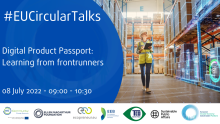
The Digital Product Passport (DPP) promotes sustainable production. The passport lists all materials and components used in a product or a building and the information on their location. Providing this information could increase the product circularity and contribute to reaching the net-zero objective.
What are the challenges ahead? What are the initiatives in place at the European level? Join us online on 8 July from 09:00 to 10:30 CEST to learn more from frontrunner stakeholders that have already conceptualised digital product passports and are operating them on the EU market.
Recovo is a B2B platform located in Spain which specialises in selling on deadstock fabric which would otherwise be classified as textile waste.
The platform helps EU-based brands and suppliers to give a second life to unused fabric. This reduces the amount of resources needed to meet buyers' needs and cuts down on waste.
Recovo uploads photos and information on fabric remnants put up for sale by producers which can then earn money from products rather than paying for waste disposal. Buyers can order samples, then buy as much of the fabric as they want which is delivered straight to them. Recovo ships within the EU, and most vendors are located in Europe, specifically Spain and Portugal.
A user-friendly platform promoting circularity and combating waste!
While digital networking is of great advantage for everyday life, the incredible amounts of electrical devices bring with it some particularly ecological risks, especially with regard to the use of resources. This is why the European Commission in the New Circular Economy Action Plan announced a Circular Electronics Initiative. There are still many challenges to be discussed during this workshop.