REPLACE - REgional PoLicy Actions for Circular Economy - is holding its final conference in Rome on 5 April 2023. On this occasion eight European Regions will showcase the results and the impact generated by this interregional cooperation project centred on environment and resource efficiency.
For the eighth time, the Cradle to Cradle NGO is inviting 1000 participants to come and debate and network at the International Cradle to Cradle Congress 2023 on 8 and 9 September.
The Congress will feature panel discussions with high-profile speakers from business, politics and science, good practices from established companies and start-ups, inspiring keynote speeches about the circular transformation of our society and many opportunities for networking.
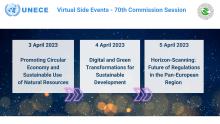
The 70th session of the United Nations Economic Commission for Europe (UNECE) will take place in April 2023 in Geneva. The Commission, UNECE's highest decision-making body, will take stock of its work to promote a circular economy and the sustainable use of natural resources.
Various virtual side events on 3-5 April will look at specific aspects of the circular economy transition, including the role of policies and institutions, innovation and private sector engagement, value chains, digital solutions and networks.
65% of electrical and electronic appliances put on the market must be collected after use when it turns into Waste Electrical and Electronic Equipment (WEEE). One key step in achieving that 65% is to map e-waste streams, reliably and at every stage. The BeWeee tool is designed to help companies in Belgium do so.
This webinar on Monitoring the Transition to Circular Economy will provide an introduction to the concept of monitoring frameworks within the context of circular economy initiatives. Drawing on experiences from the ground, it will discuss practical examples from cities and regions and related challenges.
A brief presentation of the Self-Assessment Tool, which is being developed by the Circular Cities and Regions Initiative Coordination and Support Office (CCRI-CSO), is also on the agenda.
The World Circular Economy Forum 2023 will be held in Helsinki from 30 May to 2 June 2023. This global collaboration forum is co-organised by Finnish Innovation Fund Sitra and Nordic Innovation, with international partners. It will attract more than 2 000 leading circular economy players in the world to Finland to find circular solutions that can help our economies fit within the boundaries of nature. Part of the programme will also be accessible online.
The Circular Navarre Catalogue 2022 is an update of the showcasing booklet published in 2020 and in 2021. This new edition includes 50 organisations - based on circular business models - in the Spanish Navarre region, looking for international cooperation.
Article 15 of Directive 2012/19/EU (WEEE Directive) requires producers to provide information free of charge about preparation for re-use and treatment for each type of EEE placed on the market.
To better respond to recyclers’ needs, APPLiA and DIGITALEUROPE created I4R, the Information for Recyclers Platform, where recyclers can access recycling information at product category level.
The WEEE Forum, an international association of producer responsibility organisations and a centre of competence, hosts and maintains the platform. EuRIC is on the advisory board.
Recycling information is linked to the presence and location of materials and components in electronic waste that require separate treatment. There are now 47 product fiches in six product categories.
The innovation cluster Circular Saxony aims to re-design products and processes in line with circularity and sustainability, while lowering the costs of society's transformation towards climate neutrality.
It brings together industry, research and policy representatives in thematic working groups which will work on practical solutions within the region of Saxony.
Goals:
Foster collaboration across sectors and technologies among SMEs, large enterprises, research organisations, associations and policymakers in Saxony
Transfer knowledge
Facilitate projects for members
Set up pilot lines and digital networking technology
Increase quota of materials kept in the loop for all relevant materials