The Sustainable products initiative, which will revise the Ecodesign Directive and propose additional legislative measures as appropriate, aims to make products placed on the EU market more sustainable. You are welcome to give your feedback on it until 2 November 2020.
Upcycling Scandinavia designs practical objects using upcycled materials such as paper, cardboard and pre-use plastic from industry. Its products are reusable and can be looped back into the manufacturing of new products.
A new project addressing the systemic complexities of the Circular Economy is being submitted as a Marie Curie (MSCA) post doc proposal. As these aspects build upon multi-stakeholder knowledge and insights, you are kindly invited to join the project community and collaborate.
The Donar company was established in 1989 in Slovenia, as demand for office interior development was growing. Starting as a small business, Donar has developed into one of the key players in design furniture with the highest environmental standards.
The Alliance for Flame Retardant Free Furniture welcomes the new Circular Economy Action Plan and calls on EU institutions to address the unnecessary use of chemicals preventing circularity and the achievement of climate goals, such as toxic flame retardants in furniture, which endanger people’s and firefighters’ health as they migrate out of products and can lead to increased fire toxicity.
The use of such retardants is a historical, hazardous and ineffective practice which is not proven to reduce the number of fires. It is at odds with circularity objectives and their presence in furniture runs counter to the ambition to introduce and increase circularity.
Ensuring fire safety is a must, but it needs to be done in ways that are not hazardous.
From a circular point of view, the wide range of products considered to be "furniture" and the diverse use of materials in production (e.g. wood, plastics, textile, steel, glass, composites, foam) makes it a complex area to address.
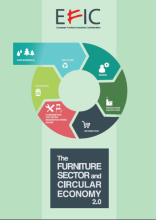
The European Furniture Industries Confederation (EFIC) has drawn up a position paper that identifies challenges and opportunities linked to the circular economy transition, covering the different phases of manufacturing from supply of materials to the end-of-life phase, and that provides sector-specific expertise on EU Circular Economy policies.
Rype Office applies the principles of circular economy to physical workspace by remanufacturing quality used office furniture and creating furniture from waste.