The public consultation 'Towards a circular, regenerative and competitive bioeconomy' ran from 31 March to 23 June 2025. It invited people to provide feedback for the future EU bioeconomy strategy, to be adopted in the fourth quarter of this year. The summary report is now available, giving an overview of stakeholders had to say.
The ECESP held the second Circular Economy Days at the World Expo 2025, with nine events over three days in five national pavilions in Osaka, Japan. This international series of events aimed to foster dialogue and collaboration among European and Japanese practitioners, policymakers, businesses and innovators in the circular economy. The session recordings are now available!
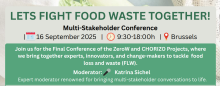
Join the final conference for the CHORIZO & ZeroW projects, a unique chance to explore multidimensional insights and solutions for tackling food loss and waste.
The European Sustainable Phosphorus Platform (ESPP) is an international platform bringing together industry, science, regulators and stakeholders with a view to facilitating sustainable phosphorus management, including reuse and recycling.
It is holding two workshops on phosphorus as a Critical Raw Material and on White Phosphorus (P4) during EU Critical Raw Materials Week.
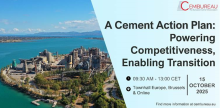
This event will explore how CEMBUREAU's Cement Action Plan can contribute to climate action and competitiveness in the EU.
The plan focuses on building climate-resilient infrastructure, delivering affordable housing, enabling renewable energy systems and ensuring strategic autonomy through a strong, local industrial base. To fully play this role, the cement sector needs a regulatory framework that enables investment, rewards circularity and supports innovation at scale.
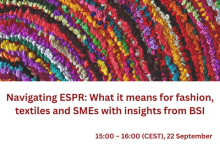
This webinar will explore the latest developments in the Ecodesign for Sustainable Products Regulation (ESPR) and what it means for the fashion, clothing and textile industry, especially SMEs.
It will unpack key components of the EPSR, including the Digital Product Passport (DPP), Substances of Concern (SoC), green public procurement, ecodesign requirements and the ban on destroying unsold goods. International and national standards on circularity and ecodesign relevant to the sector will also be introduced.
The transition to circularity in the EU needs support from policymakers and stakeholders at all levels – and that will require indicators and metrics. Complementary indicators need to be developed which expand the focus of traditional efforts to give greater attention to higher-value circularity activities and allow for the specificity of relevant policy focus areas, economic sectors and material streams.
This document is the final report of a 2-year project to identify and investigate opportunities for innovation in monitoring circularity across the EU.
It provides a baseline of policy and funding frameworks and monitoring efforts across 11 priority policy themes. 60 indicators were tested as part of the project, with conclusions and recommendations for each of the individual policy areas.
The Secretariat of the United Nations Economic Commission for Europe (UNECE) Working Party on Agricultural Quality Standards is organising a roundtable discussion with meat industry experts on traceability and circularity issues.
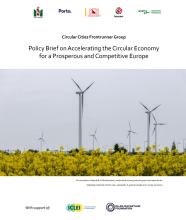
A coalition of European cities has published a policy brief calling on EU institutions to strengthen the enabling framework for local circular economy implementation. The Circular Cities Frontrunner Group, consisting of cities such as Amsterdam, Milan, Malmö, Copenhagen, Turku and Porto, has developed the brief as a shared contribution to the EU’s 2024-2029 political cycle.
The policy brief builds on a joint open letter addressed to Members of the European Parliament in late 2024 and outlines how cities can help scale the circular transition - if the right policy conditions are in place.
The brief contributes to ongoing discussions around the Circular Economy Act, the EU’s competitiveness agenda and the future of multilevel governance.
The European Commission is launching a call for applications for the third mandate of the Platform on Sustainable Finance, to run from the first quarter of 2026 to the fourth quarter of 2027. The platform is an advisory body made up of experts from the private and public sectors which advises the Commission on sustainable finance policies. Apply by 23:59 CEST on 10 September!