The ASEAN Circular Economy Forum (ACEF) functions as an annual platform for the ASEAN policy community to engage with stakeholders and explore ways to foster a more effective transition to a circular economy through national policies and regional initiatives. ACEF 2025 will spotlight how circular economy solutions can drive inclusive development, reduce inequality and foster innovation across the region.
The Horizon Europe project DECISO (DEvelopers of CIrcular SOlutions) aims to support European cities and regions as they develop financing schemes for circular economy initiatives. The project's final event will showcase how European cities and regions overcome financing barriers impeding circular economy initiatives.
This video prepared by the ECESP Leadership Group on Economic Incentives gives an introduction to economic incentives, their advantages over regulatory obligations and social education and their role in achieving a more sustainable future for all.
Lost in transition? Join RREUSE and Rete 14 Luglio at their conference in Naples to explore how the social and circular economy can provide a compass towards an economy that is truly sustainable and inclusive.
This conference offers a space for knowledge transfer and strategic exchange on circular economy in the field of public procurement. At the same time, it provides insights into European best practices and promotes dialogue on innovative approaches and synergies for successful implementation.
Join the European Investment Bank's C3 team and circular economy experts for the first event of a new C3 Circular City Seminar Series targeted at city and region representatives.
The InvestCEC project was tested in the city of Klagenfurt, Austria. At this final event, it will showcase its experience and main achievements in developing a replicable model to initiate circular economy projects in regions and cities.
This roadmap is designed to enable national governments to shift from a linear to a circular economic model.
It sets out a step-by-step process for countries, starting with planning and engaging stakeholders, then forming a dedicated team, identifying key stakeholders and thoroughly analyzing the country's current economic framework to find opportunities for circularity.
Drawing insights from global case studies, it offers practical solutions tailored to each developing country's unique context. It highlights the importance of collaborative efforts involving businesses, international organisations, academic institutions, financial entities and NGOs.
It aims to empower nations in the Global South to embrace sustainable development, environmental preservation, and economic resilience.
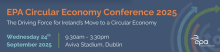
Ireland's Environmental Protection Agency hosts an annual Circular Economy Conference to discuss priority topics and highlight the opportunities and challenges in transitioning to a circular economy in Ireland.
This year's event will focus on topical areas, such as the forthcoming EU Circular Economy Act, making circular models more competitive and extended producer responsibility in priority sectors. Through ‘Local Circular Solutions’ presentations, enterprises will showcase their circular business models.
Nordic Sustainable Construction is a programme set up under the Nordic Council of Ministers. It aims to create a green transition with green growth in the Nordic societies by working toward carbon neutrality and a sustainable, circular and bio-based economy based on knowledge, innovation, mobility and digital integration.
In May 2025, it began three new work packages to create best practice guidelines for the industry and map industry structures and practices to find improved solutions.