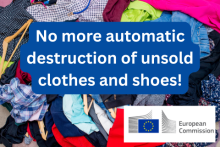
From 19 July, large companies may no longer destroy clothes and shoes which are cluttering up their shops and warehouses. Instead, they must donate them or reuse them in some way.
This CORDIS Results Pack shows how the EU is funding research and innovation to create a sustainable, climate-neutral and circular textile sector.
It showcases nine Horizon research projects focused on optimising resource use and minimising waste across the entire textile production and consumption cycle.
This event brings together six ECOSYSTEX member projects, each hosting dedicated sessions on advancing circularity and sustainability across the European textile and fashion sector.
Participants will gain insight into cutting-edge research, practical tools and policy approaches driving the shift towards circular textiles beyond recycling — with plenty of opportunities to connect with project teams and fellow stakeholders across the European value chain.
The SUSTRACK Toolkit was developed under the Horizon Europe project SUSTRACK.
It provides practical tools, policy briefs, case studies and guidance to help policymakers, businesses and researchers accelerate the transition to a circular and sustainable bio-based economy.
This session will enable participants to engage in a discussion on curbing ultra-fast fashion, regulating textile waste and advancing circular solutions for the textile sector.
It is part of Generation Climate Europe’s ongoing Youth Report on Textile Waste and aims to ensure that youth perspectives inform EU-level policy discussions and recommendations.
The Joint Initiative on Circular Economy (JICE) brings together the EU’s largest public promotional banks and institutions.
Against the backdrop of the expected EU Circular Economy Act and a shifting regulatory environment, JICE is launching a webinar series to deepen market understanding of financing needs, gaps and bottlenecks for the circular economy across selected sectors.
This event will explore how the circular economy drives EU strategic cooperation with Asia, Middle East and North Africa (MENA) and Ibero-America.
It will explore international partnerships, innovation opportunities and funding mechanisms that support sustainable development and circular economy initiatives.
The Flexireo platform aims to stop destruction being the default decision for unsold products.
It coordinates reconditioning across external partners, document recovery, recycling and disposal decisions, and ensures full ESPR-ready traceability for every product.
APARO is building an operational software infrastructure for textile circularity.
It is starting with the physical processes where circularity actually happens: collection, sorting, material movements, quality assessment, traceability and downstream flows.