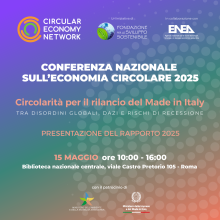
Italy's seventh National Circular Economy Conference will focus on Circularity to Boost Made in Italy.
It will look at how strengthening circular practices can help revive the Made in Italy brand and enhance the competitiveness of key industrial sectors. This is particularly relevant given the ongoing decline in national industrial output which has been exacerbated by recent global instability and trade barriers. The conference will also review the implementation of the Green Deal and recent policy developments at both EU and national levels.
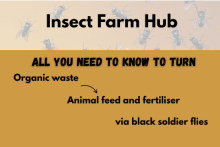
Insect farming is becoming more common, with plenty of people trying their hand at it. Like any other type of farming, however, it takes knowledge – and that is where Insect Farm Hub comes in. It aims to share knowledge about black soldier fly farming.
Circul'R and Loop have recently launched the reuse coalition for household, beauty and hygiene products in supermarkets. This webinar will present the coalition to interested brands.
The UP Scorecard is a free, easy-to-use web-based tool which enables corporate procurement agents to assess the impacts of foodware and food packaging on human and environmental health.
It was developed by a cross-industry group of leading food service companies, NGOs and technical experts using life cycle assessment science. It conveys the information in an easy-to-use way and enables buyers to compare the merits of specific food containers.
The COM4PHA research project is working on developing new bioplastics for use in the packaging and agricultural sectors. The new formulations for packaging will be biodegradable and compostable, and the coating formulations will improve product quality and extend shelf life.
The EU Ecolabel is the official European Union voluntary label for environmental excellence. It's doing well, which is good news for businesses and consumers. See the latest facts and figures!
The Forest Stewardship Council is committed to protecting healthy, resilient forests for everyone and forever.
With forests facing growing demand and pressure, they see the need to explore new solutions ensuring the best use and continuous circulation of forest-based fibres. This round table discussion will look at how this can be done.
The transition to a circular economy requires more than just recycling and material recovery: it will take a fundamental shift in how businesses operate. Product-as-a-Service is at the forefront of this transformation, offering a model that prioritises access over ownership, optimises resource efficiency and reduces waste.
This WCEF accelerator session will look at how businesses successfully implement this model and the challenges and opportunities along the way.
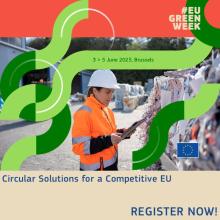
This year, EU Green Week will focus on circular solutions for a competitive EU. It will explore how the EU economy can speed up the transition from linear to circular models of production and consumption.
Circular Cities Day is part of the OECD Urban Days which brings together global leaders, experts and changemakers to discuss how to shape and finance inclusive, circular and sustainable cities.
Circular Cities Day will include sessions on Closing the loop: circular economy in European cities and regions and Circular cities and regions in action: insights from 10 policy scans (both organised jointly by the OECD and the Circular Cities and Regions Initiative).