This webinar on 7 June aims to take stock of the current EU instruments which may be mobilised by insect producers in order to stimulate the EU bioeconomy, and thereby foster the creation of ‘innovative supply chains’ and ‘green jobs’ in European rural areas.
Furthermore, the event explores avenues for developing new EU measures to unleash the potential of the insect sector in stimulating the bioeconomy as well as in diversifying and boosting the domestic production of proteins in Europe.
The EU Green Week 2023 from 3 to 11 June is the annual opportunity to debate, become familiar with, or even celebrate EU environment policy. The main event - the Brussels conference - takes place on 6 and 7 June. The policy debates on "Delivering a Net-Zero World" theme and expert workshops are organised by the European Commission, Directorate-General for Environment, with invited speakers from the world of politics, business, NGOs, and academia.
The European Commission has launched the LIFE Programme’s 2023 Calls for project proposals. This year, there are 611 million EUR available for nature conservation, environmental protection, climate action, and clean energy transition projects.
Kosovo, a potential EU candidate country, has embarked on an ambitious journey – the transition towards a circular economy. The aim of this journey is:
to preserve the country’s nature and rich biodiversity
to valorise its resources and talent,
to contribute to a more resilient and regenerative economy and a society where everyone has the opportunity to live a good life.
This roadmap by Kosovo's Ministry of Environment, Spatial Planning and Infrastructure identifies six priority areas: a) food and b) forestry systems, c) creative and d) retail sectors, e) built environment and the f) manufacturing sector.
Given the strong interdependency of these sectors, the Roadmap also introduces horizontal areas that enable and support priority areas and further promote circular transition.
On 23 May, the AL-INVEST Verde Programme, funded by the European Commission for promoting sustainable growth and job creation in Latin America, launched its second call for proposals. Join the information session and discover more about the programme and the call terms and requirements.
Two online information workshops (on 5 and 13 June) will be organised for associations, chambers of commerce and other institutions representing the private sector, research centres and think tanks. During the workshop, an overview of the programme as well as full information on the second call will be presented.
The OECD Programme on the Circular Economy in Cities and Regions, in collaboration with Tallinn Green Capital 2023 and the European Committee of the Regions (CoR) commission Environment, Climate Change and Energy (ENVE), and the European Commission Circular Cities and Region Initiative (CCRI) is delighted to invite you to the 5th OECD Roundtable on the
Circular Economy in Cities and Regions - Accelerating the Transition to a Circular Economy in Cities and Regions.
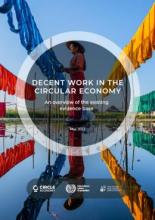
Circle Economy has partnered with the International Labour Organisation (ILO) and the World Bank Group initiative Solutions for Youth Employment (S4YE) on jobs in the circular economy. S4YE is a multi-year initiative to generate and share evidence and data for a better understand of how the circular economy can help lead to a more just and inclusive world.
This report systematically documents the literature on circular economy and jobs, identifying gaps and suggesting ways to simultaneously promote environmental sustainability and good quality jobs. It provides valuable insights for policy makers to move towards a better environment that is just for all, helping to create win-win situations that are so urgently needed for the planet, its prosperity and its people.
The sixth edition of MeetingPack, the event organised every two years by AIMPLAS and AINIA, will attract members of the entire food packaging value chain on 10-11 April 2024 at the Valencia Conference Centre in Spain.
Through the prism of the circular economy, MeetingPack 2024 will address the challenges and opportunities the sector is expected to face in coming years, as well as the latest innovations and trends in materials and barrier packaging.
The Nordic Sustainable Construction programme (2021-2024) aims to deliver the Nordic Vision 2030, which seeks to make the Nordic region (Iceland, Finland, Denmark, Norway, Sweden, Greenland, The Faroe Islands and Åland) the most sustainable and integrated region by 2030.
The programme focuses on how construction can help create a green transition with green growth in the Nordic region by working towards carbon neutrality and a sustainable, circular and bio-based economy centred around knowledge, innovation, mobility and digital integration.
The European Commission has published the revised Circular Economy monitoring framework. This framework helps to track progress in the transition to a circular economy in the EU and considers how the circular economy can contribute to climate neutrality, resilience and global sustainability. The framework includes new indicators, covering material footprint, resource productivity and waste prevention targets.