Recycling flexible PET packaging is tricky because it is made up of layers but in Spain, recycled polyethylene terephthalate (rPET) is the only type authorised for post-consumer recycled content for food packaging.
The BOTTLE4FLEX project has taken up this challenge and aims to develop 100% recyclable flexible skinpack packaging using rPET.
The ECOFAP project aims to make shoe soles and heels from a material manufactured from tanned leather waste using 3D printing. This research project will help solve the problem of how to recycle leather scraps from the footwear manufacturing industry.
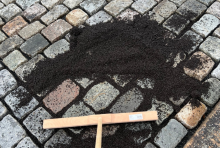
GIND is an innovative company dedicated to developing sustainable and long-lasting solutions for road surfaces and outdoor spaces. Its BIO DILE™ joint filler replaces traditional, resource-intensive and short-lived materials with more environmentally-friendly alternatives made from recycled, sun-dried stone aggregates and bio-based binders derived from cashew nut shells and natural asphalt. At the end of the filler's lifecycle, it can be fully recycled.
Berlin began its circular economy transition in 2020 with the adoption of the Waste Management Concept 2020-2030, aiming to implement measures to reduce household, water and construction waste. To advance this transition, it established the Coordination Office for Circular Economy, Energy Efficiency and Climate Protection in Business in 2022 and the Zero Waste Agency in 2023, and commissioned a study to analyse the circular economy’s potential in the industrial sector.
Despite these efforts, the circular economy in Berlin is still often perceived only in terms of sustainable waste management. This paper looks at challenges holding back progress on the circular economy, including policy coherence, and provides recommendations to accelerate the transition.
Multilateral development banks have a key role to play in supporting and financing circular approaches. Recognising this, a group of these banks came together to discuss how to better support the circular economy and promote an exchange of knowledge with the private sector, civil society, and local, regional and national authorities.
This report is a result of their work. It presents 20 case studies from around the world that highlight the kinds of support on offer, such as advisory activities, public-sector lending, private-sector investments and backing for the financial sector. Sharing these experiences is important for identifying and adopting successful approaches that can be replicated and scaled up around the world.
Revivack has set up the world's first system based on blockchain technology that facilitates the individual return of unwanted items to the manufacturer. These items can therefore be recovered in an orderly, transparent and reliable way, contributing to the promotion of the circular economy.
How many plastic bottles actually enter the recycling process?
Theory is one thing and reality tends to be another. The Czech Ministry of the Environment wanted to find out what really happens to plastic bottles after they are thrown into sorted bins for plastic waste. It commissioned Adastra to carry out a project using IoT technology to track the movement of sorted bottles.
The built environment accounts for at least 40% of anthropogenic greenhouse gas emissions. For the Alps, it is key to use local resources effectively while upholding EU rules and promoting the adoption of common standards across the building value chain.
The European Interreg Alpine Space project BAUHALPS is endeavouring to meet these challenges by developing and testing a model that combines New European Bauhaus concepts with sustainability measurements and indicators in an innovative way.
This report is part of a larger, collaborative four-year research project. It analyses the fashion value chain from a global and local perspective with an emphasis on India, Spain and the Netherlands, using a novel framework to assess social impact for circular economy called the SIAF-CE.
The report concludes that the Dutch circular ambition in policy is high and a solid ecosystem is in place. The most established circular strategies are resale and recycling, while promising ones are resale-platform-based, rental and repair. However, the social impact of most circular strategies seems to emulate linear value chain working conditions, where women workers hold the most vulnerable jobs, with low pay, short-term contracts and lower collective bargaining.
This analysis report was prepared in connection with the EU-funded Wood2Wood project and explores opportunities to advance the circular economy and overcome challenges to waste wood utilisation through supportive policy.
It outlines recommendations and policy options for improving waste wood utilisation through harmonised multi-criteria waste wood classification, refined and extended targets and obligations, enabling policy and policy which fundamentally reflects the lifecycle perspective. These recommendations and policy options serve as a point of departure to help shape the regulatory environment in support of improved waste wood valorisation.