The Whole of Government Circular Economy Strategy is Ireland’s first national circular economy strategy. The Strategy is a key addition to the Government’s drive to achieve a 51% reduction in overall greenhouse gas emissions by 2030 and to get on a path to reach net-zero emissions by no later than 2050, as per commitments in the Programme for Government and the Climate Act 2021.
The Strategy explains what the circular economy is, why Ireland needs to deliver on a circular economy and how national policy will develop to support that goal. A circular economy can have positive environmental, economic and social impacts, such as reduced plastic pollution, new jobs and better quality, longer lasting consumer products.
CircularTool is an instrument developed by Matrec to measure the product circularity. It supports designers in the product design phase as it evaluates the choice of sustainable materials and helps them apply the Circular Economy EU Action Plan strategies and the Ecodesign Directive.
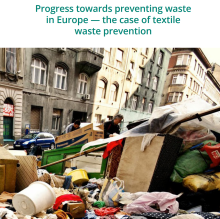
Waste prevention is the best waste management policy option, according to the waste hierarchy - the EU's main rule for the environmental ranking of waste management policies. Its main objective is to reduce waste generation, the environmental impacts of waste management and the hazardousness of the waste generated.
To support this objective, the EU and all its Member States have put in place legislation that promotes activities in products' life cycles aimed at reducing the amount of waste generated.
This report aims to assess progress towards the main objective of waste prevention: decoupling (i. e. breaking the link between waste generation and economic growth).
This briefing provides a snapshot of the status of trading non-hazardous, recyclable waste within the EU. Its aim is to provide knowledge and information to support the review of the EU's Waste Shipment Regulation.
The idea is to improve the functioning of secondary material markets by offering insights and potential solutions to help ensure that waste is treated in the best possible way in line with the principles of the waste hierarchy.
How can a "strategic stock management" approach shed light on the potential of circular strategies for critical raw materials? This reports provides insights at regional macro-economic level for policy-makers.
The future economic and environmental potential of a Flemish Circularity Hub for li-ion batteries from electric vehicles is explored as a case study with high policy relevance.
In ‘Vision 2050. A long-term strategy for Flanders’, the circular economy is one of seven transition priorities. New business models play a key role in this transition.
This paper explores incentives and barriers for consumers in adopting new circular business models - such as Product-Service Systems (PSS). Eight B2C suppliers were interviewed in the sectors of coffee, housing, electrical appliances and clothing.
The study confirms that PSS are context-dependent and emphasises the dynamic relation between producers and consumers in PSS.
Future research priorities include uncovering practical and cultural aspects of PSS, as well as exploring what it takes for PSS to be transformative in the context of a transition towards the circular economy.
This study focuses on the willingness of consumers to use circular business models (CBMs).
It assesses the ‘suitability’ of a product or sector for a particular circular business model from a consumer-based perspective: is it likely that a sufficient number of consumers would be willing to adopt the CBM to make it worthwhile for providers to enter this market?
The study aims to provide an overview of different attitudes towards a diverse set of CBMs. Specifically, it takes six scenarios concentrating on coffee, printing, housing, clothing, household chores and secondhand markets.
This approach makes it possible to compare results for a variety of CBMs as well as to identify general trends in consumers’ intentions and reported behaviour.
This report assesses how the circular economy contributes to reaching climate goals with regard to residential housing.
The draft Flemish climate policy plan covers the operational phase of housing and the material and carbon footprints of building and renovation. The report explores two ways to reduce these footprints: reducing the size of new housing and splitting existing buildings, and applying alternative construction methods or building materials and increasing the use of recycled and reused materials.
This report details the research conducted by the Steunpunt Circulaire Economie, covering the results of a consumer survey with over 2000 respondents, as well as four interviews with car-sharing companies and interest groups.
The main objective is to get a better understanding of the position of car-sharing in Flanders, what people think of car-sharing, including the barriers people face, and what impact car-sharing is having on behaviour and the environment.
The report concludes with a set of implications and recommendations for policy relating to car-sharing and its place in the circular economy.
This short-term assignment attempts to improve our understanding of the data availability of biomass flows within the Flemish economy and develops a methodology to approximate the flow of biomass between different industries.
This needs to be done in order to maximise their potential and reduce unnecessary waste flows. However, the report finds that the data currently available are insufficient, and considers that the construction of a physical counterpart to monetary input/output tables might be the answer.