Circular design is an important enabler of the transition towards sustainable production and consumption of textiles through circular business models. The design phase plays a critical role in each of the four pathways to achieving a circular textile sector:
longevity and durability
optimised resource use
collection and reuse
recycling and material use.
This briefing aims to improve our understanding of the environmental and climate impacts of textiles from a European perspective and to identify design principles and measures to increase circularity in textiles. It is underpinned by a report from the EEA's European Topic Centre on Circular Economy and Resource Use available here.
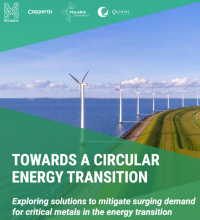
Concern continues to grow regarding the availability of critical metals. Such rare or scarce metals, like lithium or cobalt, are not only vital to the world’s major economies. They are also crucial for a transition to a renewable energy system in the Netherlands. At current levels, the global supply of these metals is insufficient, and the Dutch demand for them is no exception.
This study Towards A Circular Energy Transition serves to provide insight into the demand for critical metals domestically over the next few decades, to offer perspectives on how to reduce this demand, and to demonstrate the opportunities these new measures present to industry in the Netherlands.
Blue Room Innovation has developed a solution for some of the challenges facing ports: CIRCULARPORT. This blockchain-powered waste management solution makes ports greener and more efficient. A WastePassport has also been developed that connects waste disposed in port reception facilities to treatment plants.
The goal of the circular economy is to take full advantage of all available resources through reducing, reusing, repairing and recycling. The recent Nordic Circular Summit in Copenhagen covered topics from public administration programmes to innovative techniques and renewable practices in the marine and food industries.
What can we learn about the circular economy from the Nordic perspective? Find some answers in this position paper.
This Whitepaper presents research into existing and emerging circular business models (CBMs). This results in the identification of seven basic types of CBM, divided into three groups that together form a classification.
This white paper on Quick Scan Circular Business Models - Inspiration for organising value retention in loops from the Dutch Ministry of Economic Affairs and Climate Policy offers an approach for developing a circular business model. It is based on a classification for existing and future circular business models developed in 2021. It consists of seven basic models geared primarily to the manufacturing industry, although it can also be used in other sectors.
The paper is divided into three parts:
an introduction explaining the background and central concepts
an overview of the seven circular business models comprising the classification, and
the actual Quick Scan.
The interactive Quick Scan version can be found here.
RECICLOS provides incentives for recycling cans and plastic beverage bottles. When people recycle using the app, they receive points that can be used to try to win prizes or given to local projects.
The zero waste consultancy wegozero has mapped more than 1000 businesses with zero waste potential in four European cities. Its maps are available for a monthly subscription and aim to tell people which businesses in their city are sustainable and geared to circular thinking.
Although previous researchers have explored the circular economy practices of different businesses in various contexts, only a few papers have focused on the sustainable preparation and consumption of food in the tourism and hospitality industry. This paper sheds light on case studies from hotels, restaurants and cafés that are located in urban tourism destinations.
This research suggests that catering businesses can implement a number of responsible initiatives by introducing preventive measures and recycling practices to curb food loss and the generation of waste. In conclusion, it finds that there is scope for regulatory authorities and policy makers to encourage hospitality practitioners to minimise food waste.
SmartProSys (Smart Process Systems for a Green Carbon-based Chemical Production in a Sustainable Society) is a research initiative for sustainable chemistry and circular economy at the Otto von Guericke University in Magdeburg, Germany. It is funded by the Ministry for Science, Energy, Climate Protection and the Environment of the State of Saxony-Anhalt.
SmartProSys aims to replace fossil raw materials in chemical production with renewable carbon sources, thus contributing to a carbon-neutral society. The initiative involves researchers from the fields of systems-oriented process engineering, chemistry, mathematics, logistics, political science and psychology.
The initiative also organises events and issues a newsletter.