In March 2019, the Italian Circular Economy Network hosted a national conference on the circular economy, where it presented this Report on the Italian circular economy in 2019. Based on the methodology used, comparing the 5 most important European economies, Italy is the top performer in terms of circular economy implementation, ahead of the United Kingdom, France, Germany and Spain (in this order). While Italy’s position has remained unchanged compared to the previous year, there are some small signs of a slowdown which must be taken into account.
The report makes the following 10 proposals for a circular economy in Italy:
Spread and enrich circular vision, knowledge, research and good practices
The Circular Economy Network was set up in 2019 by the Fondazione per lo sviluppo sostenibile, supported by a group of businesses and organisations from a range of economic sectors. The Network aims to promote the development of the circular economy in Italy.
It focuses on:
disseminating publications on the circular economy;
defining key circularity indicators and analysing national performance;
analysing the main barriers and identifying solutions to them;
drawing up strategies, policies and measures to be put to decision-makers;
promoting dialogue between businesses and institutions;
With FarmacoAmico, CiboAmico and Cambia il Finale, the HERA has moved beyond its core business to actively prevent medicines, food and bulky goods from becoming waste.
REDEL is an energy provider in Italy. Its activities comprise decommissioning outdated energy installations. The PVC Upcycling project aims to initiate a circular model for reclaiming resources by:
de-manufacturing: recovering the PVC of electric cables coming from decommissioned energy plants;
re-manufacturing: recycling of the same PVC in products.
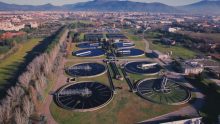
GIDA is a wastewater treatment plant that helps meet the needs of the local textile industry by supplying water of sufficiently high quality, while keeping water consumption to a minimum.
Fra’ Sole is a sustainability project involving the monument complex of Saint Francis of Assisi and its nearby areas, which has resulted in the elimination of disposable products, infrastructure for rainwater reuse and a 20% reduction in overall waste.
R-PVC Hub aims to promote cooperation between all stakeholders in the PVC recycling sector, including the businesses collecting waste, processing it and producing items containing recycled material.
One goal of the platform is to inform stakeholders about national and European rules on PVC waste and technological innovations in the field of waste sorting and management and the definition of by-products, waste and secondary raw materials.
It also links up supply and demand: businesses list what they have or need and the precise specifications of the PVC.
Enea has designed an industrial symbiosis platform intended for businesses and other entities located in Italy.
It aims to bring together supply of and demand for resources (materials, energy by-products, water, services and expertise) and create the conditions to transfer these between stakeholders. The goal is to create a network of Italian enterprises in line with the principles of industrial symbiosis.
Enterprises register and list at least one resource they want to share, and a match is identified. The platform can also analyse an enterprise's resource management system with a view to finding ways to optimise it, both internally and externally (based on collaboration or industrial symbiosis).
The potential of reusing and extending the life of products is well documented, but there is also huge untapped innovation potential in the industrial circular economy.
This involves reusing and extending the life of manufactured molecules. It's an area which is under-researched and under-exploited. It entails reusing high-purity loops of atoms and molecules rather than recycling mixed waste. Considerable chemical expertise is required, including the design of new molecules and mini-mill technologies to separate existing materials. Innovative collection and sorting processes which are not destructive and do not mix materials will also need to be developed. Policy could close the invisible liability loop by stipulating Extended Producer Liability.