Although the opportunities for investing in circular business models are widely available, current investment methods do not match the needs of these particular businesses. Businesses need to create an attractive business model for financiers, and financiers need to change the way they perceive the risks and opportunities associated with these models.
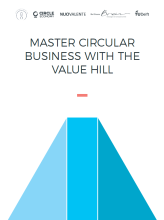
To help businesses position themselves in a circular context and develop future strategies for doing business in a circular economy, Sustainable Finance Lab, Circle Economy, Nuovalente, TUDelft, and het Groene Brein got together to create the Value Hill that proposes a categorisation based on the lifecycle phases of a product: pre-, in- and post-use.
The Circularity Gap Report 2019 finds that just 9% of the 92.8 billion tonnes of minerals, fossil fuels, metals and biomass that enter the economy are re-used annually. Circle Economy calculates that 62% of global greenhouse gas emissions are released during the extraction, processing and manufacturing of goods to serve society’s needs; only 38% are emitted in the delivery and use of products and services.
It highlights the vast scope to reduce greenhouse gas emissions by applying circular principles - re-use, re-manufacturing and re-cycling - to key sectors such as the built environment. Most governments barely consider circular economy measures in policies aimed at meeting the UN target of limiting global warming to 1.5°C above pre-industrial levels.
ICESP brings together various projects, shares experience, identifies shortcomings and opportunities in order to shine a spotlight on Italy's work on the circular economy and promote the circular economy in Italy.
It has six working groups, open to everyone: 1) Research and eco-innovation, 2) Legislative and economic instruments, 3) Measuring the circular economy, 4) Sustainable and circular supply chains, 5) Circular cities and regions, 6) Good practices.
It also has cross-cutting groups on: 1) Eco-design and circular business models, 2) Market for recyled goods, and 3) Good practices.
ICESP aims to promote dialogue and awareness raising, so stakeholders are encouraged to contribute good practices, strategies and knowledge. The resulting compilation is available to users.
On December 6, European Commissioner for the Environment Karmenu Vella and other EU representatives met Romanian government ministers and civil society leaders including ECESP Coordination Group member Dr Elena-Simina Lakatos.
The Institut national de l'Economie circulaire (France) has published a White paper on Circular agricultural and agri-food systems, which focuses on :
circular agricultural and agri-food systems: definitions, stock-taking and good practices, stakeholder awareness (consumers, professionals, decision-makers, distributors)
territorial ecology applied to agricultural and agri-food systems: synergies between enterprises, level of application, short agricultural and agri-food chains, urban and suburban farming
organic substances returning to the soil: identification of "brakes and levers" (societal acceptance, regulations, etc.), composting, methanation and other transformation techniques
appreciation of the eco-systemic services rendered.
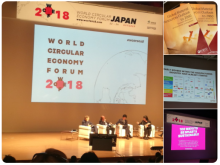
The World Circular Economy Forum 2018 took place in Yokohama, Japan, from 22 to 24 October. ECESP was represented by Ladeja Godina Košir, coordination group member for Circular Change.
On 10 October 2018, ECOSOC and the Second Committee of the General Assembly of the United Nations held a joint meeting on Circular economy for the SDGs: From concept to practice, to discuss how the transition towards a circular economy can be leveraged to accelerate implementation of the 2030 Agenda and Sustainable Development Goals.
Seminar discussing the different aspects of urban waste prevention, with a particular focus on exchanging best practices coming from European heritage cities.