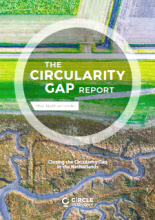
The Dutch economy is 24.5% circular. Measures in four key sectors can triple the national circularity rate and help the government achieve its ambitions for a fully circular economy by 2050.
On 3 June, Circle Economy launched the Circularity Gap Report for the Netherlands. The report shows that the Netherlands is a circular frontrunner: the country's circularity rate is three times higher than the global rate of 8.6%. Consuming 221 million tonnes of materials each year, the Netherlands retrieves one quarter from non-virgin, secondary sources. However, if the government is to achieve its ambitions of full circularity by 2050, a major overhaul of the national economy, including jobs, will still be necessary.
BusinessEurope organised two events for businesses and policymakers on challenges and opportunities for scaling up circular economy solutions in Brno and Madrid in October 2018.
In its role developing scientific research and innovation in various fields, including the circular economy, IRCEM has organised several thematic workshops and conferences.
This research note produced by Ecopreneur.eu is a 1st inventory of the potential impacts of future EU circular fashion on non-European textile producing countries. It uses existing literature and input from four circular economy experts to analyse the economic, social and environmental impacts.
Textiles and clothing play an important role in our everyday life. But the global fashion industry model is unsustainable. It uses large amounts of resources and has negative impacts on the environment and people. The global fashion industry, therefore, has to make a transition towards a circular model. In a ‘circular’ fashion economy, clothes, textiles, and fibres are kept at their highest value during use and re-enter the economy to avoid becoming waste.
This research note produced by Ecopreneur.eu is a first inventory of the potential impacts of future EU circular fashion on non-European textile producing countries. It uses existing literature and input from four circular economy experts to analyse the economic, social and environmental impacts.
In March 2019, the Ellen MacArthur Foundation launched Circular Economy in Cities, a suite of easily accessible resources which provide a global reference on the topic.
Plastics represent a serious waste-handling problem with only 10% of the plastic waste generated worldwide being recycled. Plastics recycling is instrumental to close the loop of the circular economy by re-introducing into the economy high-quality plastic recyclates incorporated into new products.
The brochure highlights the importance of moving towards a circular economy for plastics in Europe. It identifies the most commonly used types of plastics and describes the current state-of-play, challenges faced by the European mechanical plastics recycling industry and key recommendations for overcoming them. Plastics recycling’s environmental benefits and economic importance are also touched upon.
The 2019 Overview of Circular Economy in Europe by Ecopreneur.eu is a landscape review of circular economy policy across the EU Member States. It aims to inspire these countries to accelerate their circular transition.
The Finnish Innovation Fund Sitra is collecting a selection of circular economy solutions that are among the most viable, promising, scalable and impactful in the world.