The ECESP Leadership Group on Social Enterprise invites you to attend this #EUCircularTalks event on 29 November from 14:00 - 16:00 CET.
Join us and discuss how collaboration between social enterprises, the public and private sectors and others can act as a catalyst for supporting and growing social enterprises' impact in the circular economy.
Key stakeholders, from large and small social enterprises to the public sector and researchers, will highlight partnership challenges and opportunities. After the event, you will have the opportunity to continue the discussion with our panellists via SpatialChat from 15:30 to 16:00 CET.
The World Circular Economy Forum 2022 presents circular economy game-changers. Hosted in Kigali and online on 6-8 December 2022, WCEF2022 is co-organised by the African Circular Economy Alliance, the Republic of Rwanda, the African Circular Economy Network (ACEN) and The Finnish Innovation Fund Sitra, with international partners. The title for this year's event is 'From Africa to the World'.
If you are a representative of a retail SME based in a Member State of the European Union, you are invited to complete the survey "Twin transition for Retail SMEs", that is part of an independent study commissioned by the European Commission. The idea is to collect best case stories from SMEs engaged in digitalization to increase their sustainability.
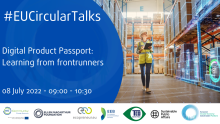
The Digital Product Passport (DPP) promotes sustainable production. The passport lists all materials and components used in a product or a building and the information on their location. Providing this information could increase the product circularity and contribute to reaching the net-zero objective.
What are the challenges ahead? What are the initiatives in place at the European level? Join us online on 8 July from 09:00 to 10:30 CEST to learn more from frontrunner stakeholders that have already conceptualised digital product passports and are operating them on the EU market.
The Roadmap - Towards the Circular Economy in Montenegro aims to steer the transition to a circular economy in Montenegro. It is based on systemic thinking and outlines the main drivers, horizontal and priority areas, opportunities for circular transformation and recommendations for the way forward.
The strategy identifies five focus areas (food and forest systems, the built environment, tourism and manufacturing) that are highly interconnected and, through the principles of industrial symbiosis and synergies, can result in systemic change.
The roadmap is an outcome of collaboration between the Montenegrin Chamber of the Economy, UNDP, Circular Change and Deloitte BiH.
The Circular Week is a series of events and initiatives dedicated to circular economy and sustainable development, taking place across Europe. It aims to promote the idea of circular economy, support sustainable business models and establish cooperation between stakeholders.
The 2022 edition will take place from 3 to 9 October. Submit your event and help close the circle!
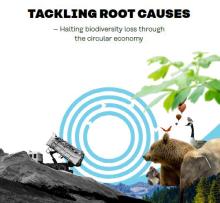
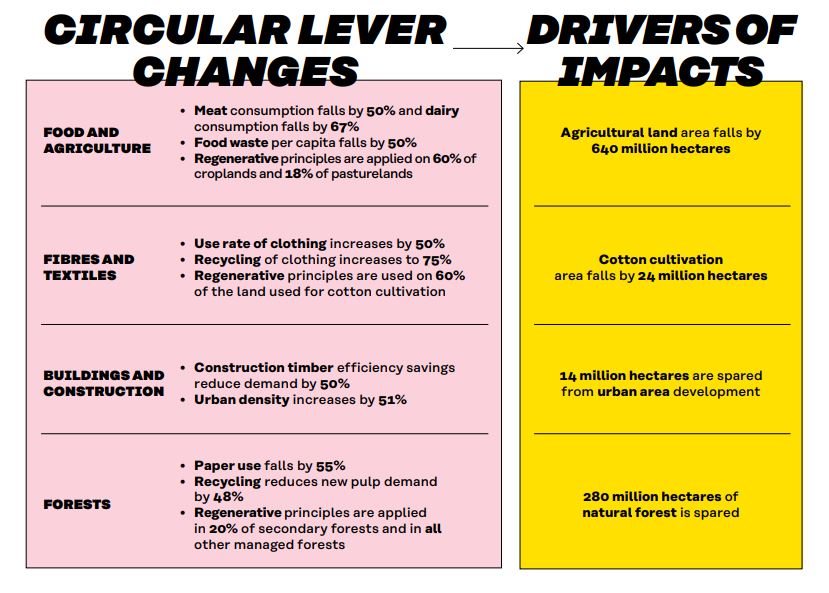
Circular economy interventions in four key sectors can halt global biodiversity loss and help the world's biodiversity recover, finds this study.
Tackling root causes - Halting biodiversity loss through the circular economy, written by experts from Sitra and Vivid Economics, is the first to quantify the role a circular economy can play in tackling global biodiversity loss, targeting the four sectors with the largest impacts:
food and agriculture
construction
textiles
forest and forestry
Circular interventions in these sectors can halt biodiversity loss even if no other action is taken. And more than that, the study finds that the world’s biodiversity can recover to 2000 levels by 2035, if the circular interventions are implemented.
Urgent global action is required to address unsustainable material resource use. This report explores the possibility of, and analyses the implications associated with, developing an international agreement on the management of natural resources.
Why an international agreement?
An international agreement could support
incentivizing action on a global level
generate awareness to tackle the issue of resource management
solve the issue of uncoordinated actions at various regional and governance levels.
The report also looks at the extent to which Free Trade Agreements (FTAs), many of them including provisions relevant to developing circular solutions, cover natural resource management and could be leveraged to enhance resource efficiency.
What are your plans for May? ACR+ will kick off an entire month dedicated to innovation and circular economy in waste management. Through several events, ACR+ will showcase some of its activities and projects fostering innovative approaches and practices to reach a circular economy.