Ambition4Circularity is a platform collecting circular commitments by large French companies. It is supported by the French Association of Large Companies (AFEP) that reflects their growing commitment to move towards a more sustainable production model.
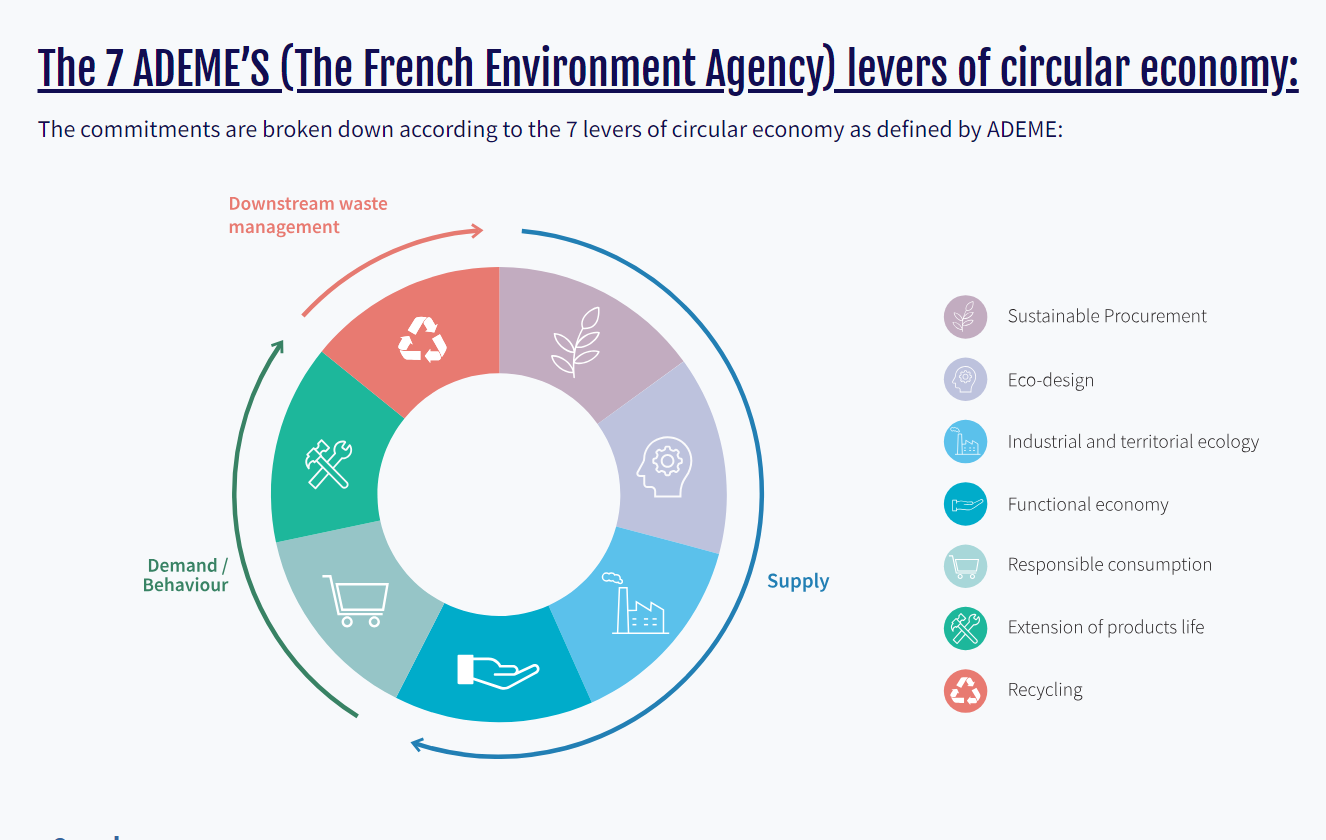
Companies have been mobilising since 2017, with a wide range of commitments to activate the seven pillars of circular economy as defined by the French Agency for Ecological Transition (ADEME) and based on their specific activities.
The commitments listed on the platform primarily involve the company’s internal stakeholders, along with suppliers, partners and customers. All aspects of the circular economy are leveraged in these commitments, from the supply of sustainable resources to the repair and recycling of the end product.
Selling or buying reconditioned items? Learn what the process involves in France!
To be recognised as reconditioned in France, an item has to follow a series of compulsory steps.
Sellers must be fully transparent about the source(s) of the product they are selling, reconditioning must take place on the premises where the product is sold or very close by. The product warranty must be extended to two years. Reconditioners should preferably use green transport and must be aware of their Extended Producer Responsibility and provide recycling bins for batteries, electrical appliances, etc. The original packaging should be preferably be used for packing the reconditioned goods.
These are just some of the rules that must be abided by in order to sell reconditioned items in France.
Delivering a just and successful circular economy transition requires engaging a multitude of stakeholders at the nexus of several areas of expertise, including digitalisation, agriculture, business management, governance and policy, innovation and finance.
This autumn, on 18 and 19 October, UNECE, in collaboration with the Ministry of Environmental Protection of the Republic of Serbia, will organise the first in-person Regional Policy Dialogue under the Stakeholder Engagement Platform - Circular STEP.
The conference on Green PLM 2023 - We enable the shift to sustainability will feature presentations and discussions on data management and digital solutions for product carbon footprints, secondary material rates and circularity.
There is a fee to take part in this conference, which will be held in Berlin on 9 November 2023. The event will be partly in German and partly in English.
Gravity Wave is a social start-up based in Spain. It focuses on working with small-scale fishermen to collect as much as possible of the plastic waste fouling the Mediterranean, from water bottles to a whole load of discarded fishing nets.
Re-think Circular Economy Forum is an event designed to present a vision on macro-trends, possible evolutionary paths, and main projects concerning the Circular Economy on a local, national and international level. It wants to encourage the development of Circular Economy in Taranto and in the rest of Apulia territory.
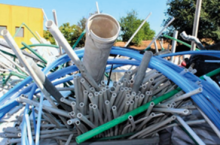
The "Waste REcycling Project" (WREP) is a pilot scheme developed by PVC Forum Italia, the national association of producers, converters and recyclers of PVC (polyvinyl chloride), in collaboration with VinylPlus, the European PVC value chain association.
It aims to make the collection, sorting and recycling of PVC waste from demolition/renovation, bulky waste and waste management centres more efficient, using a consolidated and accredited traceability methodology.
The Circular Economy Lab was set up in 2018 by Cariplo Factoryand Intesa Sanpaolo Innovation Center. It is a hub of circular economy competences that aims to help spread the principles and methods of the circular economy and support companies as they go circular.
The Lab is involved in various projects, such as the Iren Startup Award Call4Circular | Circular products and materials. It promotes the circular economy by holding workshops on key topics and by creating networking opportunities for innovative ecosystem players, such as startups, innovative SMEs, universities, research centres and technology transfer centres.
Wood is becoming increasingly important: it is key to energy, construction and decarbonisation, as well as raw material security. In addition, a raft of legislative and non-legislative measures are being prepared by the Czech Republic and the EU on the issue of wood processing and forestry.
Analysising the sector is therefore paramount. After eight months of work, the research team (Think Tank) of the Institute of Circular Economy has published a study on Closing the Loop on Wood: Circular Bioeconomy Opportunities in the Value Chain for Forest Products and Wood in Czechia. It explores the material flow of wood in the Czech Republic and the challenges, weaknesses and opportunities for cross-sectoral use.
CircEUlar is a four-year European Research and Innovation Action that will develop new modelling approaches for analysing circularity from a systems perspective.