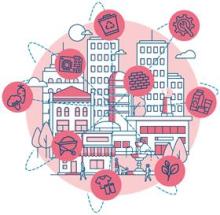
Participez à un atelier de La fresque de l'Économie circulaire, le 11 juillet 2023 de 19h00 à 22h00 CESTà Paris, pour mieux comprendre les enjeux liés à l’utilisation des ressources naturelles:
Quelles sont les ressources en tension ?
Quels impacts génèrent notre consommation ?
Comment puis-je contribuer dans mon quotidien ?
Comment les entreprises peuvent-elles faire évoluer leurs modèles ?
The Circular Republic Festival will take place from 15 to 18 November 2023. Join top circular economy visionaries for innovation, networking and inspiration. Showcase initiatives, meet relevant players and be inspired by good practices. Experience keynote speeches, panel discussions, workshops and online collaboration. We want to accelerate the circular economy together!
Academics are studying the challenge of including the informal recycling sector (IRS) in the circular economy.
This review explores the direct and indirect contributions of the IRS to various circular economy fields, drawing on relevant literature.
The modi operandi of different recycling value chains are captured in a typology.
Information on reported forms of collaboration, tensions and challenges in urban waste management is summarised in a conceptual framework to facilitate the transition to circular and inclusive wise-waste systems.
Important aspects related to circular business models and approaches to the IRS are discussed and avenues for further research proposed.
The first episode of the Biocircularcities Trilogy unveils the story behind the success of the BBI-JU Biocircularcities project or how partners supported a transition of the pilot territories toward circular bioeconomy through a collaborative approach.
Siptex is the world’s first large-scale facility for sorting textiles by colour and fibre composition through near-infrared light to handle large flows and produce textile fractions suited to different recycling processes. As textile waste is a growing concern around the world, innovative solutions are required to tackle this environmental problem.
Kosovo, a potential EU candidate country, has embarked on an ambitious journey – the transition towards a circular economy. The aim of this journey is:
to preserve the country’s nature and rich biodiversity
to valorise its resources and talent,
to contribute to a more resilient and regenerative economy and a society where everyone has the opportunity to live a good life.
This roadmap by Kosovo's Ministry of Environment, Spatial Planning and Infrastructure identifies six priority areas: a) food and b) forestry systems, c) creative and d) retail sectors, e) built environment and the f) manufacturing sector.
Given the strong interdependency of these sectors, the Roadmap also introduces horizontal areas that enable and support priority areas and further promote circular transition.
This hybrid session on 8 June explores the linkages and concrete actions that should be considered by investors and project owners when developing circular and long-lasting, place-based skills and workforce.
This online session on 2 June 2023, from 10:00 to 12:00 (GMT+2), explores how cities worldwide can unlock the potential of the circular economy at the local level, while promoting biodiversity and nature conservation.
This session on 1 June 2023 (10:00 – 13:00 local time or 9:00 – 12:00 CEST), hosted by the Circular Buildings Coalition (CBC), will provide insights on Europe's built environment, including the carbon budget of the construction industry, the development of secondary materials markets, and effective strategies for scaling up circular buildings with experiences from the CityLoops project.
Join this session on 25 May 2023 from 10:30 to 11:30 CEST to catch up with the DEFINITE-CCRI project and the Project Development Assistance services offered to cities and project owners to develop bankable circular economy projects and secure financing.