The benefits of transitioning to a circular economy outweigh the disadvantages. However, more efforts are needed to move from conceptualisation to implementation. The transition requires a political commitment and the right business mindset. It also requires prioritisation and investment in innovation, the utilisation of new technological solutions, and the right set of skills and competences.
So far, there has been very limited focus on what skills and competences are needed for this transition and whether Nordic STEM education provides them. This report introduces the basis for a Circular Economy Competence Framework for STEM specialists, including a set of essential technical and analytical skills for creating circular solutions.
Circular Threads aims to paint a picture of sustainability and circularity practices in the fashion and textile industry in Northern Italy.
This study is a starting point for fostering the transition towards circular production models in the Italian textile industry. Researchers have developed a tripartite approach (desk research, questionnaire and circularity assessment) with different levels of granularity to measure the sustainability and circularity of the companies present in this area.
The report highlights how few companies in the fashion and textile industry are adopting circular practices and strategies, and a clear lack of knowledge sharing about the potential opportunities that the circular economy can offer businesses on a systemic level.
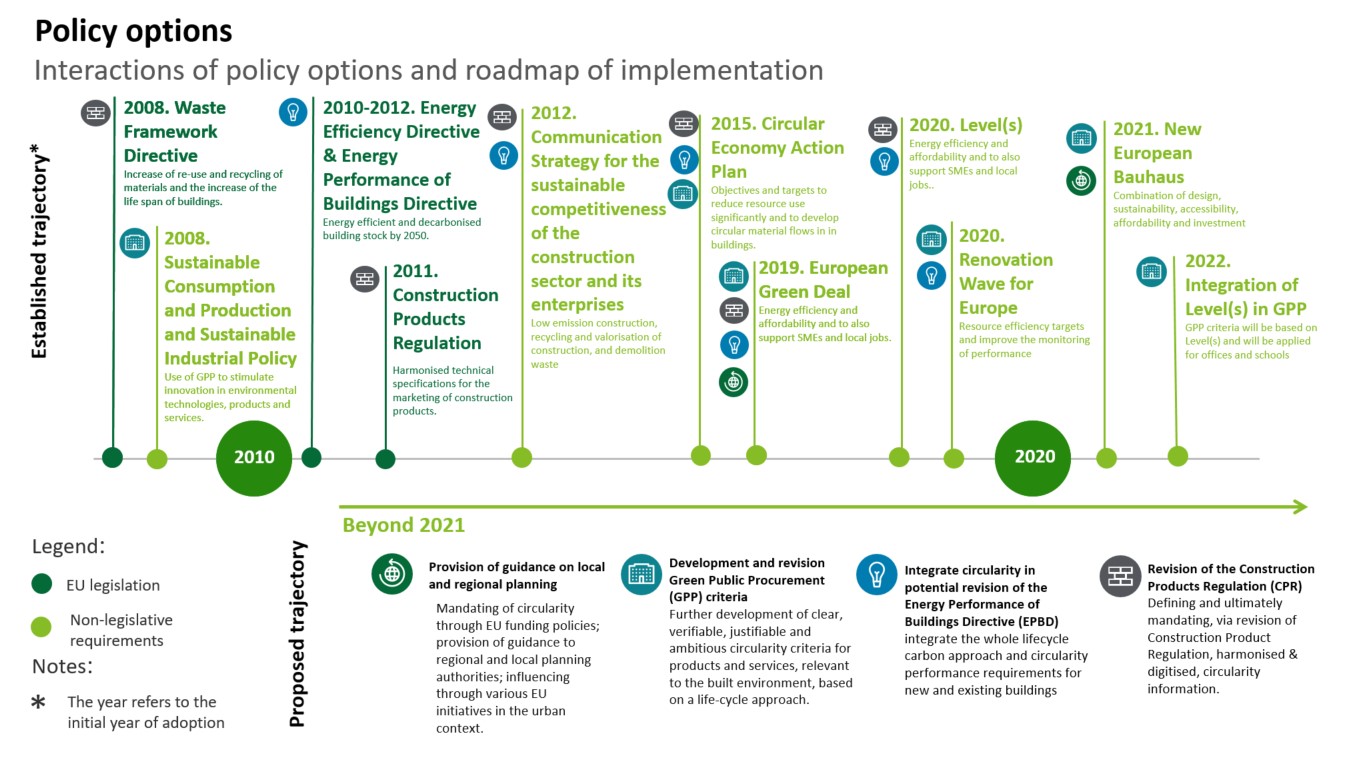
This study aims to assist the European Commission to identify policy options that support the uptake of circular economy principles for buildings’ design in European, national and local policies.
The goal is:
to increase the service life of buildings
to facilitate the use of secondary materials and
to improve resource efficiency across the building life cycle.
The study also provides key insights and recommendations on actions for a roadmap supporting the uptake and implementation of circular economy principles for buildings’ design.
By designing and enabling the use of Electric Vehicle (EV) batteries for multiple use-cycles, valuable materials are maintained, and a range of economic and environmental benefits can be unlocked.
Innovators from the automotive industry, Dutch and French public authorities, and the European Commission have collaborated to identify regulatory barriers to reusing EV batteries as energy storage devices and unlock solutions.