As part of London Circular Economy Week, CLG Europe’s Materials and Products Taskforce will be hosting a webinar setting out EU circular economy policy.
Public authorities - policymakers, procurement professionals, local and regional authorities, and other public sector actors - have an important role to play in the transition towards a more circular built environment and have a range of policy levers at their disposal to stimulate demand for circular skills. Using circular strategies in the built environment can help reduce the embodied emissions of building materials by 50%.
This interactive webinar will show how to train staff and how local authorities can work with stakeholders to train the whole value chain to promote circularity.
The webinar will present the guidance for policymakers as well as training materials developed by the BUS-GoCircular project. It will also explain how public authorities can use the Fundamentals Training Packs for SMEs in their requirements in tenders.
In the context of the data needs for EU policies in economic activities related to circular economy, climate change mitigation, climate change adaptation and bioeconomy, in 2019 Eurostat initiated a project implemented by Prognos and DevStat to develop a method that allows deriving key economic variables on these activities, which can be used as a framework also for other transition sectors.
This Prognos study contracted by the European Commission and Eurostat, and published in 2023, is a description of a generic conceptual framework to define various sectors of the environmental economy, identify activities, and analyse data by using different data sources (e.g. national or regional data).
Other documents produced under the same project can be consulted here.
Nordic Circular Summit is the biggest annual conference on the circular economy in the Nordic region. NCS2023 will take place on 17–18 October, both in person in Reykjavik, Iceland and online. It will be co-hosted by Nordic Circular Hotspot and Nordic Innovation and is an official World Circular Economy Forum Side Event and a pre-event to the prestigious Arctic Circle Assembly.
This EC GPP Helpdesk webinar on 27 September will analyse how public procurement can be used as a strategic tool to support the upskilling and reskilling of the construction workforce and help futureproof the European construction sector.
The BRILIAN project is designed to support the adoption of sustainable and cooperative business models in rural areas, enabling a smoother transition to bio-based economies. It plays a fundamental role in revitalising these regions and promoting sustainable economic and social development by transforming primary producers into active players in the supply chain, aligned with the goals outlined in the Common Agricultural Policy (CAP), the Green Deal and the European Bioeconomy Strategy.
After Pazardzhik, Barcelona and Naples, the Biocircularcities partners are coming to Brussels on 28 September. Come and be inspired to bring the Biocircularcities approach to your garden by learning more about the project and its results. Discuss the future of a circular bioeconomy in Europe and exchange notes with your peers.
It aims to influence policy discussions by enabling progressive businesses across sectors and value chains to join forces. It brings together companies committed to using climate neutral and sustainable materials and which are raising awareness about the need for EU measures to help decarbonise materials.
The key objective is to drive the development and implementation of and support for more ambitious, future-proof policies, programmes and initiatives in Europe with a view to creating an ecosystem moving rapidly away from the energy- and resource-intensive production of materials.
Denmark is already excelling in many areas of sustainability, positioning itself as an ambitious frontrunner in the race to net-zero. It already boasts mostly renewable electricity generation, with targets to achieve 100% green electricity by 2027 and entirely renewable energy by 2050.
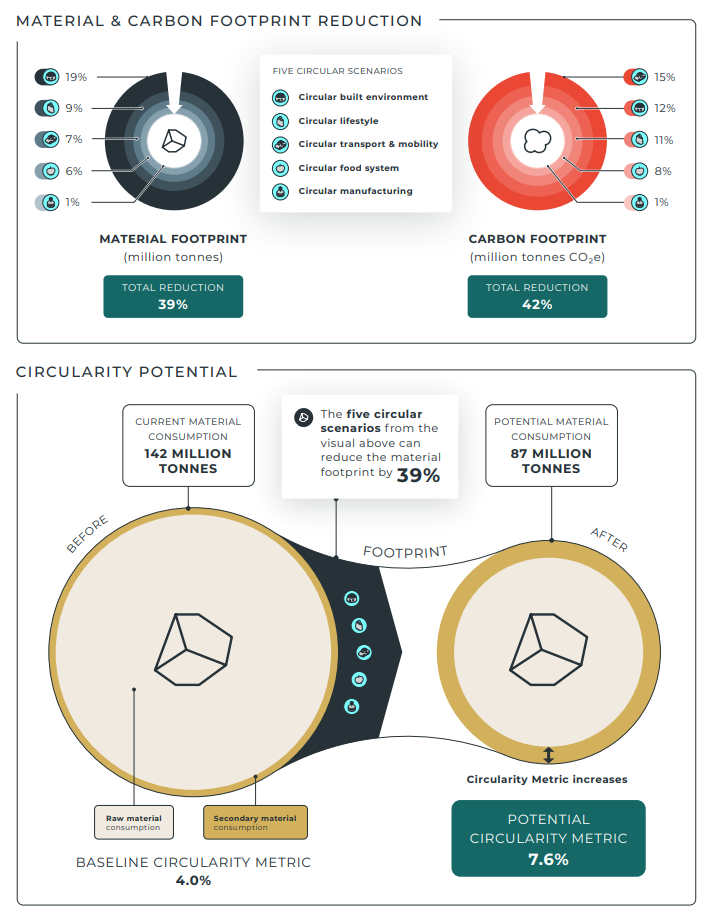
The Circularity Gap Report on Denmark reveals that the country’s economy is 4% circular. This figure is defined by very high material consumption - 24.5 tonnes of virgin materials per person per year. This puts the country above both the European average of 17.8 tonnes per capita and the global average of 11.9 tonnes per capita.
The report also lays out five circular pathways for Denmark that have the potential to cut its material and carbon footprints by roughly 40% each.
Join this workshop on 10 October on citizen engagement during the 2023 European Week of Regions and Cities in Brussels! The event is organised in collaboration with the EU projects ARV, syn.ikia, oPEN Lab, and the FinEst Centre for Smart Cities.