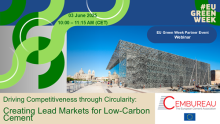
This webinar brings together experts and representatives of EU institutions and local initiatives to discuss the latest policy developments and practical solutions. It will spotlight how territorial cooperation helps drive innovation and sustainability across Europe.
Come and see how cooperation across borders can deliver tangible impact - and how these efforts can shape the future of EU environmental and economic policies!
How can the circular economy in the built environment drive climate change mitigation?
During this EU Green Week partner event, experts and stakeholders from three Horizon Europe projects – CIRCOMOD, CircEUlar and CO2NSTRUCT – will discuss innovative circular approaches that can transform the sector.
Due to rising demand and shrinking supply, the built environment and its raw material suppliers must align with regenerative cycles. This thesis aims to create a circular procurement framework to determine and preserve building asset value at end-of-life, establishing transparent, measurable standards that reduce waste and optimise resources.
It creates a transparent and measurable standard for the circular procurement process, reducing waste and optimising resource use. The thesis focuses on four major deliverables: a database of site and inventory inspections, an exit scenario and resource recovery plan, a partial deconstruction plan, and an online marketplace for resource trading.
The framework uses existing tools and indicators to establish the circular procurement process.
The European Commission is hosting a special webinar to show how the Level(s) common language framework for the sustainability performance of buildings supports early-stage qualitative assessments and reporting.
The session will dive deep into how Level(s) performance indicators help buildings professionals prioritise aspects of sustainability and align client and design team expectations from the concept stage of a building’s lifecycle.
Circular Summit Fryslân 2025 will highlight the power of regions in shaping a circular future.
With keynote speeches, hands-on working sessions and inspiring field trips, this event will bring together circular changemakers with a view to fostering international cooperation.
The Plastics Technology Centre, AIMPLAS, is launching the AIMPLAS Challenge Forum. It will bring together international experts, companies, universities and research centres to address the significant challenges facing the plastics industry and explore innovative solutions through research and collaboration.
On 21-22 May, Tondo will host Re-think Circular Economy Forum Milan 2025: two days of seminars, round tables and networking occasions on the circular economy.
IFAT Munich is the world’s leading trade fair for environmental technologies.
It is a solution platform, a networking event and a knowledge hub, and brings together the key international industry representatives from politics, business and science. Find out about cutting-edge solutions for water, recycling and circularity, with a strong focus on innovations with a global impact.