The European Environment and Sustainable Development Advisory Councils Network brings together advisory bodies offering independent advice to national or regional governments and parliaments on climate change, environment and sustainable development.
The vast majority of EEAC members work in particular on the transition towards a circular economy model. With representatives from academia, civil society, the private sector and public bodies, the EEAC network brings together experts with years of experience producing analysis and recommendations that should enhance the shift to a circular economy at sub-national, national and EU level.
The New Circular Economy Action Plan identifies textiles as a key product value chain where there is potential to boost the EU market for sustainable and circular textiles. The European Commission has launched a public consultation to gather input on challenges and gaps as well as opportunities for the sector towards sustainability.
ACR+ is launching a publication on the development and implementation of circular bioeconomy strategies in different contexts, focusing on three detailed regional case studies in Navarre, Bayern and Flanders.
Under a cooperation agreement with the French Pays de la Loire region, ACR+ has set up a working group on the circular bioeconomy, with a focus on governance. The working group aims to support the development of local and regional roadmaps for the circular bioeconomy, as public authorities steer and support the development of the circular bioeconomy on their patch.
The publication is the result of activities implemented by ACR+ through the working group.
The Grand-Duchy of Luxembourg is a frontrunner in many economic sectors, including finance, construction, data-driven innovation and space resources.
In recent years, the country has sought to position itself as a hotspot for the circular economy (CE) and many ongoing public and private initiatives support this claim.
Based on these fruitful experiences and the recognition of the CE as a high priority by the Luxembourg government, which has made it a major feature of the 2018-2023 Government agreement, the current strategy aims to take the CE in Luxembourg to the next level. It identifies proven regulatory, financial and information management methods and tools for boosting circular initiatives, and proposes a methodology for using them in a number of key economic sectors.
The final study report on Circular construction and renovation - Actions and recommendations to the Federal government for accelerating the circular economy in construction proposes actions to be taken by Belgium's federal government (and thus the regional levels as well), with a view to accelerating renovation and circular construction with respect to building materials.
More specifically, the study aims to identify relevant instruments, obstacles and measures which are either needed or already underway, and to issue general recommendations for the federal authorities. The study does not address ways to put these measures into effect or possible changes in the instruments.
The New Consumer Agenda provides for the establishment of a Consumer Policy Advisory Group. There are still several seats to fill, and the European Commission would encourage environmental organisations and individual experts to apply. The deadline for applications is 20 May 2021.
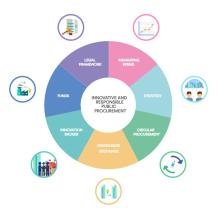
This E-Learning module on Innovative and Responsible Public Procurement guides learners, for instance, through the process of building a procurement strategy and procuring in a circular way.