You are invited to follow GACERE's (Global Alliance on Circular Economy and Resource Efficiency) first high-level meeting online on 14 September 2021 in the sidelines of the upcoming World Circular Economy Forum.
France adopted its comprehensive Anti-waste Law in 2020. The law aims to eliminate waste and pollution from the design stage and transform the system of production, distribution and consumption from a linear to a circular economic model. It encourages businesses across various sectors, municipalities and citizens to eliminate waste and adopt more circular practices.
Policymakers, municipalities, NGOs and businesses worked together with the public administration to identify a richer range of needs, solutions and policy measures. As a result, the law is ambitious and contributes to a system-wide transition towards a circular economy.
Discover the ECESP Coordination Group's work plan 2021 which aims to advance the circular economy and bring the community together. The Group members will use their expertise and tackle issues in eight areas identified as being key for the transition to a more circular economy.
This model reinforces Wallonia's objective of renewing its industry and will ensure that the region is better able to cope with future crises.
The strategy will achieve this by fully integrating the alterations and adaptations required by climate change, and by making Wallonia more independent in terms of resources and global supply chains.
Wallonia’s vision is based on the following guidelines:
Moving towards a carbon-neutral economy;
Moving towards a resilient and inclusive economy;
Stimulating innovation as a catalyst with emphasis on the digital transition and nature-based solutions.
Particular attention is paid to the six value chains: Construction, Plastics, Food, Water, Textiles and Metallurgy.
Over the past decades concepts such as sustainability and industrial development have slowly come to the same operational logic, as demonstrated by a growing interest in exploring and describing the synergy between developments in the circular economy and industrial digitalisation. There is agreement on their complementarity evolution paths, but no outlook is available regarding the co-evolution staging and structuring. This paper based on desk and empirical research presents an approach to outline the likely path of evolution.
So far, the notion of transition to sustainability has been applied in single sector studies, while reality indicates that the systemic change required cuts across thematic technologies and sectors. The approach taken can be useful to enrich current analyses.
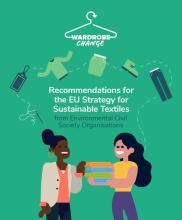
This joint position paper from the Wardrobe Change coalition contains recommendations for the EU Strategy for Sustainable Textiles. It has been signed by 25 civil society organisations. The paper sets out recommendations structured around four overarching principles:
Make sustainable textile products the norm
Drive resource-sufficient textile consumption
Leave the linear business model behind
Hold the EU textile industry responsible for its role in the world.
Discover the ECESP Coordination Group's work plan 2021 to advance the circular economy and bring the community together. The Group members will use their expertise and tackle issues in eight key areas identified as essential for the transition to a more circular economy.
The Intermunicipal Community of the Tâmega e Sousa is a public entity composed of 11 municipalities in Northern Portugal. It has developed a circular project aiming to enhance circular economy achievements and green transition agendas within local authorities, municipal companies and intermunicipal entities. In this regard, it has created the manual Economia Circular nas Compras Públicas on circular economy in public procurement to assist municipalities.
The manual presents an in-depth mapping of circular economy practices for a Portuguese strategy for ecological public procurement, as well as indications on how to address the circular economy challenge, with a range of criteria and procedures for public procurement.
This is a crucial time for shaping the Circular Economy in Ireland. The country's draft Whole of Government Circular Economy Strategy is currently open for public consultation and will be discussed live on Instagram on Wednesday 26 May 2021 at 14:30 IST (UCT+1).
In January 2021, the European Circular Economy Stakeholder Platform (ECESP) applied for the European Ombudsman Award for Good Administration. The Platform is a nominee in the category "Excellence in citizen-focused services delivery". Vote for project 25 – Giving civil society a say on green transition – to help us win the public vote award!