The transition to a Circular Economy requires innovative business models that stimulate optimised use of repairable products, reusable components and recycling of materials. Experts from different fields have collaborated in a Community of Practice (CoP) to improve the financeability of circular construction. This report retraces the 'learning-by-doing' trajectory of this CoP.
When Dublin's Ballymun suburb was scheduled for regeneration, a local environmental project redeveloped the neighbourhood's heating plant into a 3D textbook on repair, reuse and refurbish. The Rediscovery Centre, housed in the old boiler house, is now a cutting-edge creative space connecting people, resources and ideas that includes four social enterprises.
The first seminar on 'the City as a Business Model' was held at the Radboud University in Nijmegen, the Netherlands on 4 October. It aimed to share knowledge and discuss about how cities can make the transition to sustainable, inclusive circular economies, based on various European best practices.
Seminar discussing the different aspects of urban waste prevention, with a particular focus on exchanging best practices coming from European heritage cities.
Examining the role of selective waste collection in a CE by focusing on two different waste streams (plastics and bio-waste) while also granting consideration to the future of highly selective collection streams.
Despite resource efficiency improving 41% between 2000 and 2016,with the Circular Economy Package and the initiatives set out in the accompanying Action Plan nearing completion, the EU institutions must acknowledge that the move to a more resource efficient or “circular” economy will take time. To invest in new business models, more resource-efficient processes and new supply chains for good quality secondary materials, businesses need the assurance that the resource efficiency agenda will remain a priority for the EU in the long term.
This briefing sets out a range of policy recommendations that the Aldersgate Group believe EU institutions should continue to pursue beyond completion of the Circular Economy Package to scale up business action on resource efficiency.
Circular City Governance - An explorative research study presents the results of an empirical research study into current barriers and governance practices in circular city transitions across Europe carried out by a team from the Radboud University Nijmegen School of Management (NL). The research activities ran from October to December 2017. The main objective of the study was to support the European Investment Bank (EIB) and other members of the Urban Agenda Partnership on Circular Economy involved in the working group on “Circular City Governance” (CCG) with the identification, analysis and elaboration of actions in support of Circular Governance in Cities, particularly through better knowledge and better funding.
The World Economic Forum’s Future of Urban Development and Services Initiative has released its new White Paper on the Circular Economy in Cities: evolving the model for a sustainable urban future.
This White Paper traces the conceptual underpinnings of the Circular Economy, and explains why cities are key to accelerating the transition away from the traditional ‘take-make-dispose’ model. It draws on examples from cities around the world in areas that include: channelling used building materials to new building sites, water harvesting and reuse, reducing energy use, electronic waste, healthcare and procurement. It explains the opportunities in the Circular Economy for all stakeholders and the ways in which they can work together at city level.
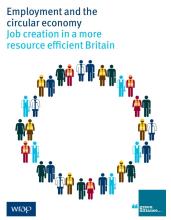
Britain faces huge economic challenges in its use of labour and scarce natural resources. Although unemployment is now falling, the risk of being out of work is higher in some regions and for some types of occupations. While Britain has significantly increased its resource efficiency in recent years, supply risks in an increasingly competitive global economy mean that we need to get better at using natural resources. A new research study, undertaken jointly by WRAP and the Green Alliance, shows that these challenges are linked: improving our resource efficiency can make a valuable contribution to improving Britain’s labour market situation. One route to improving resource efficiency is to develop a circular economy.