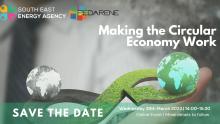
FEDARENE’s Vice-President for Circular Economy, John Carley is pleased to invite you to the webinar on Making the Circular Economy Work which aims to guide local and regional authorities as they devise their circular economy strategies.
Are you involved in a local circular economy activity? Join the Hubs4Circularity Community of Practice launch event on 24 February to learn about our opportunities in advancing circular value chains, and help us shape our new knowledge platform to meet your needs.
The World Circular Economy Forum 2023 will be held in Helsinki from 30 May to 2 June 2023. This global collaboration forum is co-organised by Finnish Innovation Fund Sitra and Nordic Innovation, with international partners. It will attract more than 2 000 leading circular economy players in the world to Finland to find circular solutions that can help our economies fit within the boundaries of nature. Part of the programme will also be accessible online.
The European Cluster Collaboration Platform (ECCP) is an online hub.
It aims to strengthen the competitiveness and sustainability of Europe’s industrial ecosystems, particularly SMEs, improving their performance in terms of productivity, innovation, internationalisation and resource efficiency through a variety of modern tools:
Events to foster capacity building and peer discussions
Matchmaking events
A knowledge database mapping regional, national, international and sectoral cluster networks, toolkits and publications
Partner search and exchange facilities to link up offer and demand
Support for international cooperation
Their Green Transition Support Hub, with a network of institutions offering support for resource and energy efficiency, addresses circularity.
The World Circular Economy Forum 2022 presents circular economy game-changers. Hosted in Kigali and online on 6-8 December 2022, WCEF2022 is co-organised by the African Circular Economy Alliance, the Republic of Rwanda, the African Circular Economy Network (ACEN) and The Finnish Innovation Fund Sitra, with international partners. The title for this year's event is 'From Africa to the World'.
By using residual streams, we can take a big step towards a circular, sustainable food system. This shift does require cooperation, however...
Foodvalley NL aims to promote the shift to a sustainable global food system. One of its projects is the Upcycling Community: an international group of partners collaborating on upcycling food losses. There are still many barriers to this circular approach, however, so they are focusing on:
bringing together a diverse and impactful group of business partners with a shared interest in upcycling food losses;
encouraging purchasers and product developers to replace virgin ingredients;
Following the success of Lignofuels 2022 which brought 150+ senior industry professionals to Helsinki in June 2022, we are pleased to announce that the 2023 conference will be taking place in Helsinki again on 8-9 February 2023.
Coffeefrom is an innovative project from Italy. It recovers coffee grounds from the food industry and blends them with biopolymers to form a new bio-based material that is a durable and resistant alternative to single-use plastic.
WaVa - Co-products Marketplace is a chemical exchange platform where professionals can sell their manufacturing co-products or buy raw materials. It matches up supply and demand.
Any industrial raw material, waste, by-product or manufacturing co-product can be traded on the WaVa platform, but its chief focus is managing and processing chemical by-products. It aims to help people achieve their circular economy objectives and thus reap the economic and environmental benefits.
WaVa is not recognised as a waste disposal facility; it simply connects buyers and sellers. It never actually takes ownership of the product.