Maria Nikolopoulou, member of the European and Economic Social Committee and keen supporter of circularity, reflects on the circular economy as a recipe for success in an article published on Open Access Government.
The LOOP-Ports circular economy project, coordinated by Fundación Valenciaport and co-financed by EIT Climate-KIC, will organise its final conference in an online format open to the public, on 16 December as an official side event of the World Circular Economy Forum Online hosted by the Finnish Innovation Fund Sitra and its partners.
The EU-financed LEVEL-UP project offered circularity protocols and strategies for extending the remaining useful life of large industrial equipment and assets that can no longer remain competitive in the Industry 4.0 paradigm.
CIRCULÉIRE is Ireland’s National Platform for Circular Manufacturing. It aims to help deliver circular business model innovation by unlocking the value that resides in an Irish circular economy.
It is an industry-led public-private partnership with 25 Founding Industry Members (MNCs and SMEs alike) which aim to become circular economy exemplars in Ireland.
The platform has an innovation fund dedicated to implementing systems-level innovation demonstration projects. It has developed various tools to help businesses go circular: the Circular Economy Infographic, the Circular Maturity Model and the Circularity Action Plan.
CIRCULÉIRE has also set up the CE knowledge library, a collection of good practices.
The University of Malta has developed a patented process that recycles limestone and concrete construction and demolition waste into masonry products. These have superior mechanical properties compared to natural limestone products.
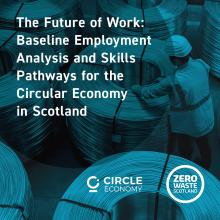
This report explores the implications of the transition towards the circular economy for the Scottish labour market. It presents a baseline measurement of the number and geographical distribution of jobs currently related to the circular economy in Scotland and explores the types of circular jobs, roles and skills associated with opportunity areas in three value chains: construction, bioeconomy and capital equipment.
Circle Economy and Zero Waste Scotland designed this report to support enterprise agencies, workforce development, governments, universities, employers and other representatives to recognise the potential of the circular economy for the Scottish labour market and the related skills development needs of its workforce as part of a just transition.