Join the European Commission Green Public Procurement Helpdesk's webinar on Public Procurement of Green and Circular Skills, which will take place on 10 March at 10:00 - 11:30 CET and is free of charge.
The webinar will analyse how public procurement can be used as a strategic tool that can support the upskilling and reskilling of the workforce and help futureproof the IT and furniture sectors.
The 2022 Circular Cities Declaration Report is a very important milestone. Not only is it the first progress report for the European Circular Cities Declaration, it also features statements from 40 signatory cities. This makes it the broadest ever assessment of circular economy practices across European cities.
The report shows that considerable progress is being made: half of the 40 cities involved in the programme already have circular economy strategies in place or in development.
This is just the start. By the end of 2025, the aim is to have 150 cities signed up to this Declaration. Together, the signatories are embedding circularity into European cities!
Cities are hubs of humanity, often fuelling a country’s economic growth and innovation. However, they are also resource and energy hungry. As a result, cities are critical when it comes to helping societies shift to a circular economy.
The 2022 Circular Cities Declaration Report is a very important milestone. Not only is it the first progress report for the Declaration, it also features statements from 40 signatory cities. This makes it the broadest ever assessment of circular economy practices across European cities.
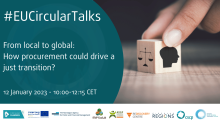
The ECESP Leadership Group on Circular procurement and the Leadership Group on Social Circular Hubs invite you on 12 January 2023 to their next joint #EUCircularTalks. Join the panelists to discuss the social impact of procurement in a circular Europe for developing countries. You will also learn how European procurement proceedings can integrate social aspects. The event will focus on the theory and dive into very concrete cases.
On 15 December 2022 the H2020 Pop-Machina community will gather once more in a hybrid event to exchange lessons learnt, best practices, and success stories over the Circular Maker Accelerator programme that has been successfully executed in several municipal makerspaces, effectively supporting over 100 makers.
The Economic Cooperation and Trade Division of UNECE organises an online and in-person event titled "Regional Policy Dialogue: Sustainable and Innovation-Enhancing Public Procurement to support Circular Economy Transition in the UNECE region" on 15 November (8:00-9:45 CET), which will also contribute to the development of a policy brief on Sustainable and Innovation-Enhancing Public Procurement.
There can be no doubt that circular demand creates opportunities for circular supply. But how can closed loop criteria be integrated into public procurement, which represents nearly 14% of Europe's GDP? To figure it out, Renewable Matter interviewed Helena O'Rourke-Potocki and Simon Clement, respectively circular economy and procurement officer and senior coordinator on the circular economy at ICLEI – Local Governments for Sustainability.
ICLEI is a global network working with more than 2 500 local and regional governments committed to driving local action towards a social and ecological transition. In future, whether purchasing services or products such as buildings, furniture and food, local authorities will need to look for increasingly sustainable supplies.
This roadmap supports governments in their goals to work towards 100% circular procurement and commissioning. The roadmap provides for a step-by-step plan that helps to design the implementation process and select actions needed.
The Hydro Ben project focuses on resource recovery for reuse in other industrial activities. It consists of recovering fatty substances from wastewater in professional catering facilities, by means of a special device which is placed under the sink.