The ASEAN Circular Economy Stakeholder Platform (ASEAN CE Platform) is a regional facility helping Association of Southeast Asian Nations Member States achieve sustainable consumption and production by accelerating the transition to a circular economy.
The EU-ASEAN Strategic Partnership covers the circular economy, and the Platform is part of the EU-ASEAN Partnership on Circular Economy, endorsed by ASEAN Senior Officials on the Environment in 2018. The ASEAN CE Platform is hosted by the ASEAN Centre for Sustainable Development Studies and Dialogue at the College of Management, Mahidol University in Bangkok, Thailand.
The establishment of the Platform was inspired by the success of the European Circular Economy Stakeholder Platform in providing access to CE good practices and strategies.
360° Foodservice is the collaborative platform dedicated to promoting the sustainable service of food and beverages across Europe.
It encompasses the whole supply chain of the foodservice packaging sector, from manufacturers to end-of-life solution providers. It unites companies that provide reuse and/or single use solutions for safely serving food and beverages to millions of Europeans every day, regardless of the materials that are used.
Collection and recycling must be in place for single use items once they have done their job. Reusable items must be collected and sanitised before being used again, and recycled when they reach the end of their useful life.
Members work towards promoting the sustainable evolution of single use and reuse systems for serving food and drinks in Europe.
With the 9 Ilhas Circulares website, the Portuguese public authorities aim to promote a more sustainable lifestyle on the Azores islands.
It is a collaborative online space for exchanging or selling surplus materials, secondhand items and circular services.
This online marketplace has 525 registered users. It fosters a culture of sharing among community members and facilitates donations, with a focus on supporting those in need. In addition to showing products to buy or sell, the platform offers access to a variety of repair, recycling and upcycling services. It has a section on good practices and a space for promoting companies and entities with a sustainable business model.
The Access Economy Alliance promotes the sharing economy: the concept that you don't need to buy something if you're only going to use it a few times.
It aims to develop the network of sharing stations, self-service lockers where you can go to borrow everyday items, from DIY tools to sports equipment. It is also a forum where access economy practitioners can engage in strategic discussions, meet other organisations in the field, learn from experts and contribute to access economy innovations.
Public authorities, businesses and researchers come together to accelerate Europe’s transition to a circular economy through access-based services.
The Alliance is supported by the EU through the Digital Kiosks project which is piloting 22 new sharing stations across Europe.
ACCEZ is a platform which aims to foster circular economy practices in the southern Netherlands.
It pools initiatives by several regional universities and public and private actors in the following fields:
area development
circular agriculture
manufacturing industries
plastic.
The platform bolsters cooperation between partners to develop solutions to knowledge-intensive issues. To do so, they oversee and fund triple-helix research projects. The end-goal of the platform is to enhance the regional knowledge base and networks, with a view to substantially accelerating the transition to a circular economy.
The African Circular Economy Network (ACEN) aims to build a restorative African economy that generates well-being and prosperity for all its people.
It carries out research relevant to the African context and its needs, raises awareness and promotes training on the concept, benefits, principles and practice of the circular economy, and fosters networking.
The network is active in 43 countries. In 2017 it co-organised the first Circular Economy Conference in Africa with the European Union and the South African Government (World Economic Forum Africa, Durban) and it was present in WCEF2022 and WCEF2023. It engages with the EU to discuss ways to be inspired by the African continent.
ACR+ is an international network of cities and regions keen to promote sustainable resource management and accelerate the transition to a circular economy in their area and beyond.
They are working for a future with vibrant cities and regions where economic and ecological systems go hand in hand. This should be achieved by policies geared to fair distribution of wealth and resources and fair access to public services, guaranteeing positive effects on the environment and public health.
They welcome a wide range of stakeholders from Europe and beyond: from local authorities and city networks to NGOs, academics, private partners and consultancies.
Ambition4Circularity is a platform collecting circular commitments by large French companies. It is supported by the French Association of Large Companies (AFEP) that reflects their growing commitment to move towards a more sustainable production model.
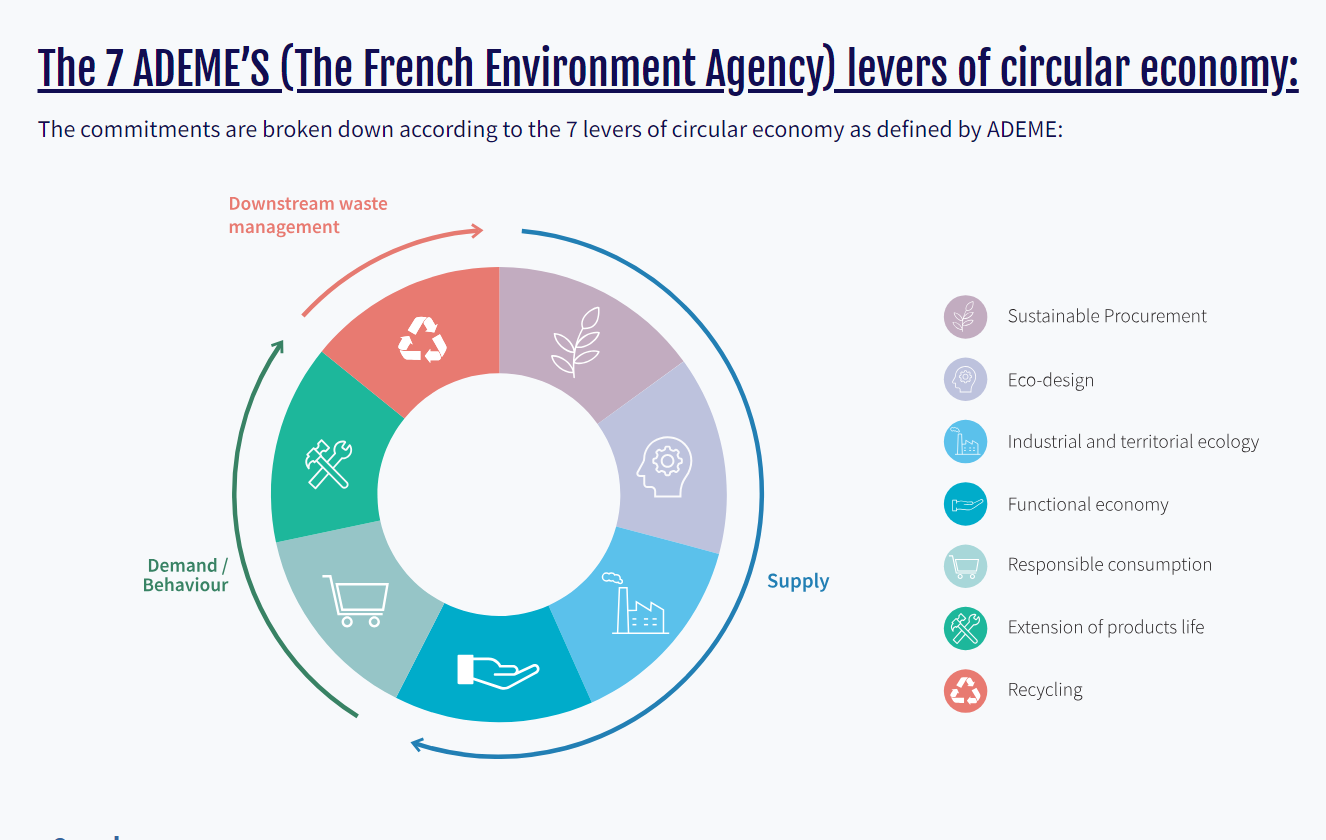
Companies have been mobilising since 2017, with a wide range of commitments to activate the seven pillars of circular economy as defined by the French Agency for Ecological Transition (ADEME) and based on their specific activities.
The commitments listed on the platform primarily involve the company’s internal stakeholders, along with suppliers, partners and customers. All aspects of the circular economy are leveraged in these commitments, from the supply of sustainable resources to the repair and recycling of the end product.
ASPAPEL is a Spanish association for pulp and paper manufacturers. They work to promote the sustainable and competitive development of their member companies, focusing on applying circular methods to the recycling of used paper.
Their key areas are:
environment,
energy,
forestry,
recycling,
industrial relations,
occupational risk prevention,
public communications.
The association is governed by a General Assembly and a Management Board with assisting committees and working groups.
BatteReverse is a research and innovation project funded by Horizon Europe with a focus on reverse logistics, whereby goods are transferred from their final destination back to the point of origin in order to recover their value or reduce waste.
This project wants to develop a process for increasing the safety, efficiency and sustainability of Li-ion battery reverse logistics. Specifically, it is focusing on developing the technologies, processes and partnerships necessary to build a reverse logistics value chain, from end-of-first-life to decision making on their future use.
The BatteReverse Community brings together battery stakeholders, experts and enthusiasts to network and exchange ideas about battery circularity.