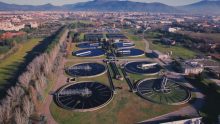
GIDA is a wastewater treatment plant that helps meet the needs of the local textile industry by supplying water of sufficiently high quality, while keeping water consumption to a minimum.
Ultra Thin White Topping is a road hardening innovation, applied to pilot projects in Frysland and Overijssel by Schagen Infra BV.
To replace damaged asphalt sustainably, the company renovated the degenerated road surface using a thin layer of cement with polyester fibres mixed in. This reduced resource consumption and enabled full material recovery at end of life.
NAFIGATE’s Hydal Biotechnology uses waste cooking oil to produce a fully biodegradable and biocompatible PHA biopolymer named Hydal (Polyhydroxyalcanoates). This is the first biopolymer of its kind being produced on an industrial scale at an affordable price.
SK-Tex takes old clothing and turns it into products that can be used in cars, furniture and buildings. The company has been in operation since 1998, beginning as a textile raw materials trading company before developing into a recycling company.
When designing the varioPrint 135, Océ (which changed its name to Canon Production Printing in 2019) partnered with the Netherlands Enterprise Agency and Philips to experiment with the use of recycled plastic in the production of industrial printers. The company has made a further step towards circular economy and succeeded in developing an internal component that contains at least 30% post-consumer recycled polycarbonate.
SuperDrecksKëscht® promotes the creation of an environmentally friendly society that protects its energy and resources, as part of the Luxembourg waste management strategy.
Infinited Fiber has developed a technology that can turn cotton rich textile waste into new fibres for the textile industry. Not just once, but infinitely. These new Infinna™ textile fibres can be recycled again and again without decreasing the quality of the fibre.
ReLondon is a partnership of the Mayor of London and London’s boroughs which aims to improve waste and resource management in the capital and accelerate its transition to a low-carbon circular city.
Generally, it wants to help London waste less and reuse, repair, share and recycle more.