The Lithuanian Commune DIY, a team of skateboarding professionals and enthusiasts, collects old, broken Canadian maple hardwood skateboards that have lost their original purpose and recycles them 100 %. The new products made of skateboards are sustainable, strong and have a new life span which is longer than the one of an average skateboard deck.
Tarkett is pioneering post-use flooring recycling in Europe. It is working with IKEA to transform used Tarkett flooring from the IKEA Kungens Kurva store into new flooring.
Tarkett worked with the Swedish environmental company Ragn-Sells to develop carbon negative mineral fillers for vinyl flooring using Estonian oil shale ash.
Bioforcetech aims to reduce energy and labour costs while reducing emissions and generating by-products (fertilisers) with added value. The company's vision is simple: instead of transporting "waste", machines are designed to transform organic streams into renewable energy and biochar right at the wastewater plant.
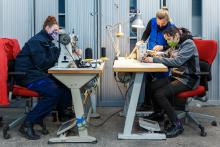
remesh is a socio-professional business workshop with an environmental impact. Most of its employees are women from disadvantaged background. The workshop is also providing a circular economy business model as they reuse advertising banners and meshes to make new products that are fashionable but sustainable.
The Italian Cartiera is an ethical fashion workshop founded in Lama di Reno, Marzabotto, in 2017 which makes leather and fabric items.
Believing strongly that work is an extraordinary tool for social inclusion, Cartiera offers paths for employment and integration of disadvantaged people, mainly refugees and asylum seekers.
Clear Fashion, independant expert of garment evaluation, is a solution that informs consumers on brands' practices and clothes' impact, and enables fashion brands to communicate their scores, in order to bring more transparency in the fashion industry.
Blue Room Innovation has developed a solution for some of the challenges facing ports: CIRCULARPORT. This blockchain-powered waste management solution makes ports greener and more efficient. A WastePassport has also been developed that connects waste disposed in port reception facilities to treatment plants.